USAID DEC
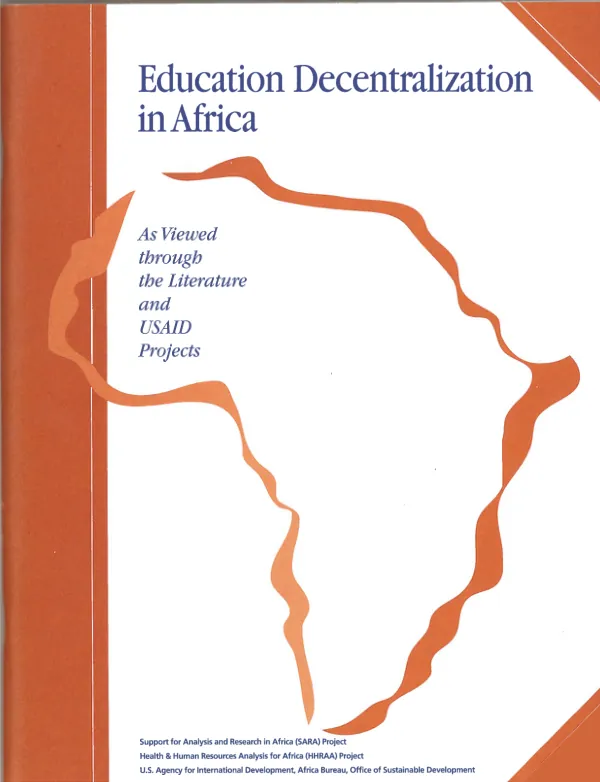
Education decentralization in Africa, as viewed through the literature and USAID projects
Sign inACADEMY FOR EDUCATIONAL DEVELOPMENT, INC. (AED)
Education decentralization in Africa, as viewed through the literature and USAID projects
Decentralization is being discussed throughout Africa, often as a panacea for broad political, social, or economic problems.
Whitacre, Paula · 1997
Sign in to readA free account is required to download.
Abstract
This document synthesizes existing information about the status of education decentralization in Africa, especially in relation to USAID"s activities in 11 countries: Benin, Botswana, Ethiopia, Ghana, Guinea, Lesotho, Malawi, Mali, Namibia, Uganda, and Zimbabwe. Material was gathered through a desk review of documents from USAID education projects in Africa, case studies of decentralization (primarily from the World Bank and USAID), and theoretical literature on decentralization. Part I of the document overviews decentralization, distilling the views of leading researchers. It then summarizes the findings from the literature, organized in four categories: (1) assumptions and views about decentralization (e.g., decentralization is often seen as an end rather than a means; its effects are assumed to be always good); (2) the process of decentralization (decentralization often emerges from crisis, is rarely designed with popular participation, rarely builds new organizational linkages, and rarely extends to the school level); (3) support for decentralization (support is often stronger from NGOs and community organizations than from government; both support and opposition are highly politicized); and (4) evaluation of decentralization (evaluation is virtually non-existent, tends to focus on planning rather than implementation and to ignore costs). Four tables provide an overview of decentralization efforts in the 11 countries, and are followed by profiles of each country. In Part II, a preliminary analytic framework is developed from the literature review, consisting of a series of guided questions that can help determine the status of a decentralization strategy in a country. Suggested questions for future decentralization research follow. Includes bibliography.
Related documents