UNIVERSITY OF NORTH CAROLINA AT CHAPEL HILL. CAROLINA POPULATION CENTER
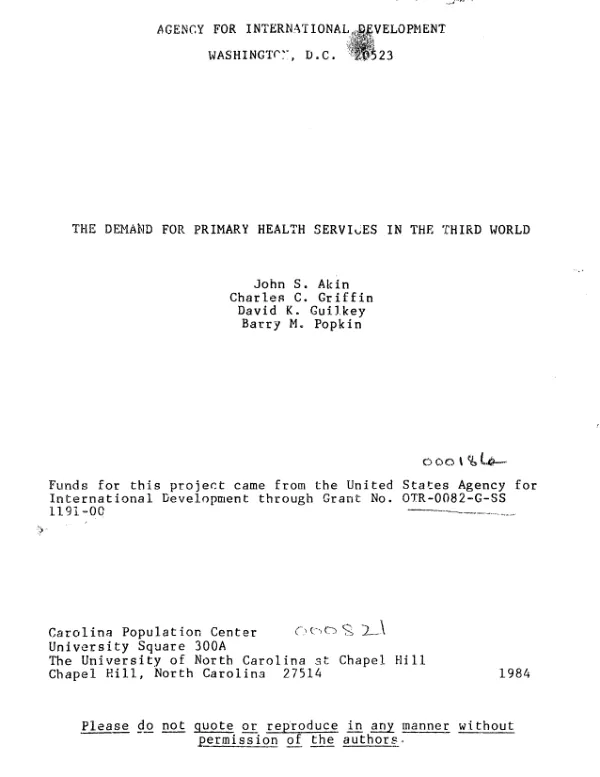
Demand for primary health services in the Third World
Although rural health services are apparently badly needed in developing countries, they are often underused by target populations and difficult to finance.
Akin, John S.; Griffin, Charles C. · 1970
Sign in to readA free account is required to download.
Abstract
Using microeconomic theory and household-generated data, this study analyzes the determinants of Third World primary health care consumption patterns and how national medical policies can be made more effective. Following a brief introduction to the economic, social, and behavioral determinants of health care use, the study reviews existing traditional and modern (public and private) health service patterns in the Third World. The most common pattern is for the government, through its ministry of health, to operate a pyramid-structured network of public facilities. Next, using an economic framework, the determinants of health care demand (price, income, time allocation, health needs, demographics, urbanization, knowledge and information, and seasonality) are more thoroughly discussed. A selective review of economic health care demand models and a detailed analysis of medical practitioner use in the Philippines" Bicol region follow. A final summary examines policy issues and options for improving the effectiveness of health programs around the world. Appended are a detailed economic analysis of health care demand, tables listing model variables, and a 226-item bibliography (1939-83).
Connected topics