USAID. MISSION TO BOLIVIA
Democratic institutions
Summarizes mid-term evaluation of a project to strengthen the electoral system and the legislature in Bolivia.
1995
Sign in to readA free account is required to download.
Abstract
The evaluation covered the period 8/88-8/94. The objectives for the electoral system component of the project have been largely achieved. Three elections were held and considered fair, the number of persons registered rose by some 700,000 between 1991-1993 to reach a total of 2.4 million, and there was a substantial decline in the incidence of mistakes in operating voting tables and in the number of nullified votes. The training program exceeded targets, reaching nearly 80% of the persons staffing the voting tables in the 6/93 elections. A permanent registration system was introduced. The principal shortfall was the failure to conduct all the planned civic education campaigns. While the objectives of the work with the legislature have not yet been fully achieved, important progress has been made in reorganizing the budget analysis office, the products of which have been well-received. The bill drafting and information management offices are still in he process of obtaining equipment and establishing working relationships with sources of information and assistance; the constituent outreach service support office is still in the conceptualization stage; the State University of New York (SUNY) has established a good relationship with the President of the Congress; and assistance from the U.S. government has proven acceptable to the Congress. The key shortfalls have been lack of detailed planning for establishing and strengthening service support offices, delays and shortfalls in counterpart funding for equipping these offices, and lack of response to requests from these offices for prolonged on-site TA. The following lessons were learned. (1) The major responsibility for policy dialogue should be assumed by USAID, rather than implementing agencies. (2) Over-reliance on ESF-generated counterpart funds for meeting operating expenses of a project can cause undesirable effects if such funds are reduced or cut. (3) If the Mission adopts the approach of having final designs of activities prepared by implementing agencies, it should require adequate forward planning and compliance with work plans. (4) Approaches to analyzing sustainability should be adopted and applied early on. (5) The Mission"s use of technical personnel supplied by or through USAID/W was beneficial. (6) Unless the Mission is generously staffed, it is not likely to be able to provide the support that an institutional contractor can.
Related documents
Documents in this collection
 1997
1997USAID DEC
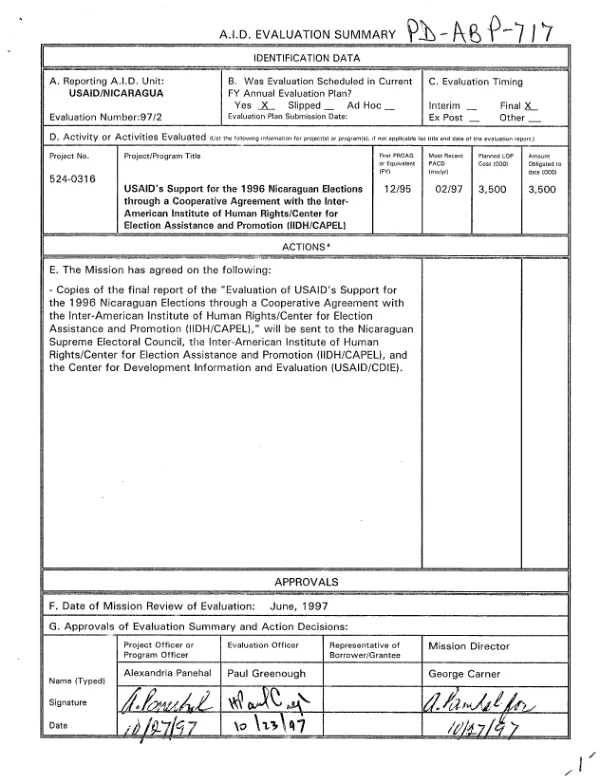
USAID"s support for the 1996 Nicaraguan elections through a cooperative agreement with the Inter-American Institute of Human Rights/Center for Election Assistance and Promotion (IIDH/CAPEL)
Open record 1996
1996USAID DEC