DEVELOPMENT ASSOCIATES, INC.
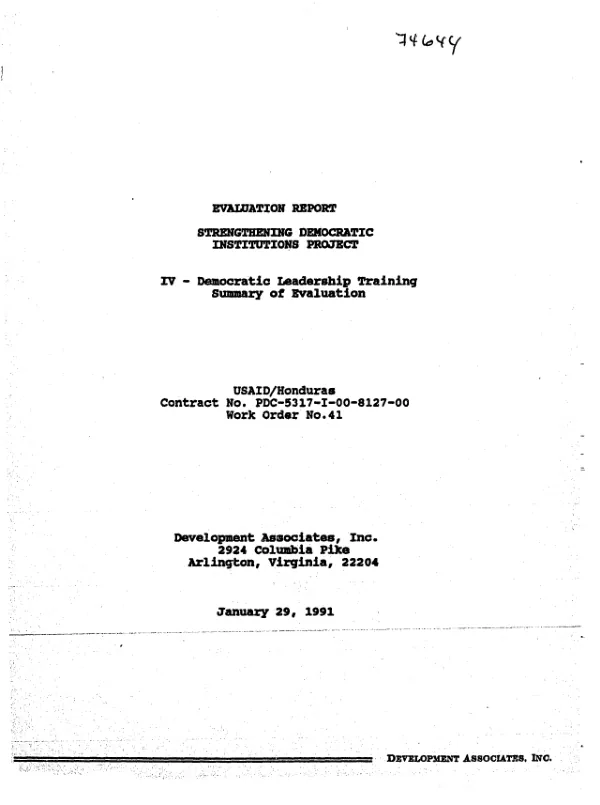
Democratic leadership training : summary of evaluation
Evaluates project to strengthen democratic institutions in Honduras.
1991
Sign in to readA free account is required to download.
Abstract
Mid-term evaluation covers the period 9/87-12/90 and covers a project component to offer conferences and seminars in democratic processes for local elected officials and community leaders. The evaluation also offers summary reflections on, and lessons learned from, the project as a whole. The only activity undertaken to date under this component, which is an adjunct to the three main components (administration of justice, legislative enhancement, and voter registration and elections improvement), has been a series of seminars -- six on political theory and eight on the principles of economics -- organized for union members by the American Institute for Free Labor Development. While the seminars seem to have been well received, there has been no effort to determine their impact, and their content is only marginally related to the project purpose. This component is begging for a strategy, a plan, some thought. It could be used to promote discussion about, and possibly foster support for, some of the unfilled conditions precedent and covenants in the Memoranda of Understanding for the other project components. Other groups besides labor unions are worthy of some attention. Support for formal and informal civic education could also be fostered. A major policy issue that arose during the evaluation was a lack of progress in creating career services in the three counterpart agencies, a step that is considered essential to depoliticizing democratic institutions. The evaluation found no evidence that this issue had been brought to high levels of the Government of Honduras. However, subsequently some progress has been made, particularly with respect to implementation of the Judicial Career Law. Implementation progress has lagged in all components, due partly to lengthy contracting delays and partly to inadequate staffing within USAID/H (the latter remains a problem), partly to unsatisfactory (and at times recriminatory) contractor-USAID- counterpart relationships. Two other negative factors have been: (1) the 11/89 election, which virtually brought all other activities under the project to a halt; and (2) the project's rush to update National Registry data without adequate analysis of the problem or the proposed solution. The project's potential impact on women was not addressed in the design stage, nor has it been considered during implementation. USAID/H should fund a study to determine to what extent women are able to exercise their right to vote, to run for office, and to be members of Congress and of the judiciary. The principal conclusions regarding the design of the project are as follows: the assumption that there was commitment by political leaders to change has not been borne out; there was inadequate study of the issues surrounding cleansing of the voting rolls, leading to an attempt to do something on a crash basis, which even if successful might not have contributed to a higher credibility for the election; given the extreme political sensitivities surrounding the election, one would have expected the design to have provided for a less obtrusive role for USAID than it had played in the 1985 election; although the PP speaks of compartmentalizing the different components so that delay or problems in one component would not create problems for the others, the actual design had the opposite effect. Four general lessons have been learned. (1) The attempt to implement this project as an umbrella project with three components, rather than as two or three distinct projects, did not really reduce management workload. Implementation difficulties and delays seem to indicate that the umbrella concept is not worth maintaining. (2) There is a lack of information sharing about common problems affecting Central America. Neither the Mission nor the contractor are well informed about similar Agency activities in other countries in the region. (3) It is not in the best interest of either the United States or a host government to place the A.I.D. symbol on equipment or supplies to be used in polling places. A.I.D. should waive this requirement in the future. (4) Since the project was a new type of initiative for A.I.D., it would have benefitted from broader based and unrushed planning. A.I.D. should also establish mechanisms to obtain outside review and advice fairly regularly during project implementation.
Related documents