COOPERS AND LYBRAND
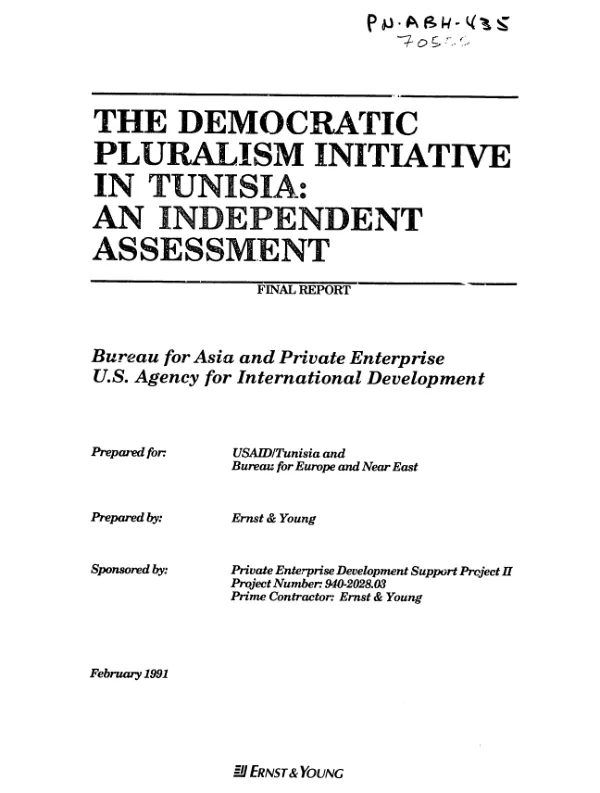
Democratic pluralism initiative in Tunisia : an independent assessment
Since the November, 1987 change of government, Tunisia has taken steps towards developing a pluralistic political regime.
Harik, Iliya; Zmerli, Boutheina +1 more · 1991
Sign in to readA free account is required to download.
Abstract
However, rapid progress in the first year of the new regime has not been matched in the subsequent period. The largest opposition movement, the Islamic al Nahda, and several smaller opposition groups still lack official recognition, while political activists and the press are subject to harassment. A.I.D. has implemented several activities to support democratic pluralism within this context. The primary focus has been to strengthen the private sector"s role in the economy through the Democratic Pluralism Initiative and the Private Sector Revitalization program. The Mission has also provided a modest amount of support to Tunisian human rights organizations, women"s groups, and the labor federation. In addition, the Mission is planning to assist the government in its decentralization efforts. Other activities indirectly contribute to the promotion of democratic pluralism. For example, youth skills training reduces unemployment and the potential for explosive unrest. These activities are making useful contributions to Tunisia"s transformation process and should be expanded. In particular, the Mission should (1) go forward with its plan to use counterpart funds to finance local non-governmental organizations working in community development; and (2) continue to send leaders of prominent opposition parties to study the workings of political systems in the United States or other democratic countries, and include al Nahda in these outreach efforts.
Related documents