USAID DEC
Deployment and Experimental Evaluation of Micro-Grid Systems
The integration of renewable energy sources (RES) has been promoted to overcome environmental constraints and the scarcity of fossil energy sources.
2018 · 6 pages
Sign in to readA free account is required to download.
Abstract
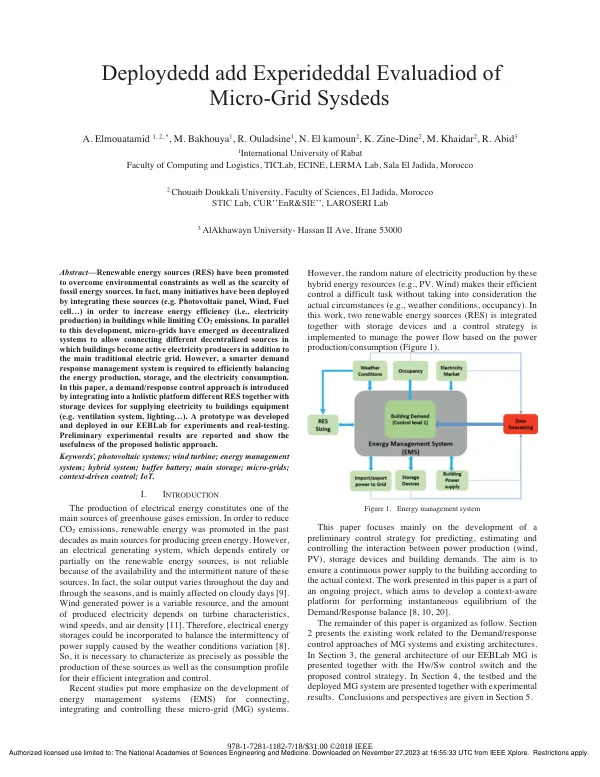
Many initiatives have been undertaken by combining RES such as photovoltaic panels, wind turbines, and fuel cells to increase energy efficiency while limiting CO2 emissions. Micro-grids have emerged as decentralized systems that enable the connection of various RES, allowing buildings to become active electricity producers in addition to the traditional electric grid. However, a more sophisticated demand response management system is required to balance energy production, storage, and consumption. The development of a demand/response control approach is presented in this paper, which integrates RES with storage devices to supply electricity to building equipment. A prototype was developed and deployed in the EEBLab for experiments and real-testing. Preliminary experimental results demonstrate the effectiveness of the proposed approach. The production of electrical energy is a significant source of greenhouse gas emissions. To mitigate this issue, renewable energy has been promoted as a primary source of green energy. However, electrical generating systems that rely entirely or partially on RES are not reliable due to the availability and variable nature of these sources. The integration of energy storage devices can help balance the power supply caused by weather conditions. Recent studies have focused on the development of energy management systems (EMS) for connecting, controlling, and connecting micro-grid systems. However, the random nature of RES production makes efficient control challenging without considering actual circumstances such as weather conditions and occupancy. This paper presents a preliminary control strategy for managing the interaction between power production, storage devices, and building demands. The proposed control strategy aims to ensure a continuous power supply to buildings according to actual circumstances. The work presented in this paper is part of an ongoing project that aims to develop a context-aware platform for performing instantaneous equilibrium of the demand/response balance. The remainder of this paper is organized as follows: Section 2 presents existing work related to demand/response control approaches of micro-grid systems and existing architectures. Several studies have focused on integrating and controlling hybrid systems, such as PV-Wind, PV-Wind-battery, PV-Wind-Diesel, and PV-Grid. Authors in [1] used neural networks as a strategy for controlling a PV-Diesel system, optimizing diesel generator operation while minimizing fuel costs. Authors in [2] proposed a dynamic strategy for charging/discharging batteries according to electricity production and consumption. However, these studies have limitations, such as ideal batteries without considering losses or cycles in battery lifespan. The architecture of micro-grid systems is another crucial aspect to consider when deploying these systems. Different topologies can be defined based on the nature of the energy (AC or DC) and the type of loads to be supplied. Two primary types of architectures are series and parallel architectures. The series architecture involves delivering renewable energy to a DC or AC bus before powering loads, which has disadvantages such as battery overcharging and low efficiency. In contrast, the parallel architecture features two busses, AC and DC, allowing for more flexible control and reduced power failure risks. The system components do not need to be sized for the total load, and the system can be managed by supplying loads from alternative sources in case of a source failure.
Related documents