USAID DEC
Modeling and Performance Evaluation of an Air-Soil Exchange System in Energy Efficient Buildings
Sign inUNIVERSITY OF MARYLAND
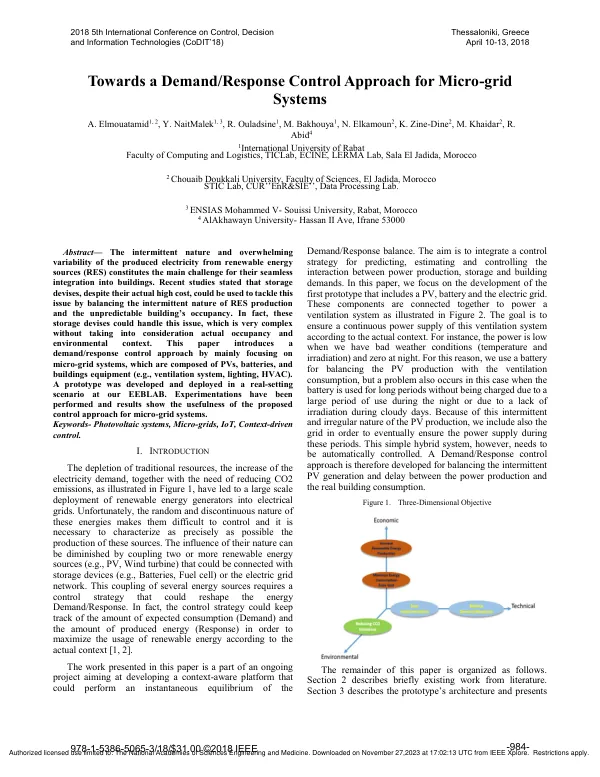
Modeling and Performance Evaluation of an Air-Soil Exchange System in Energy Efficient Buildings
The air-soil exchange system in energy-efficient buildings is a promising technique for precooling air in summer and preheating it in winter.
2018 · 6 pages
Sign in to readA free account is required to download.
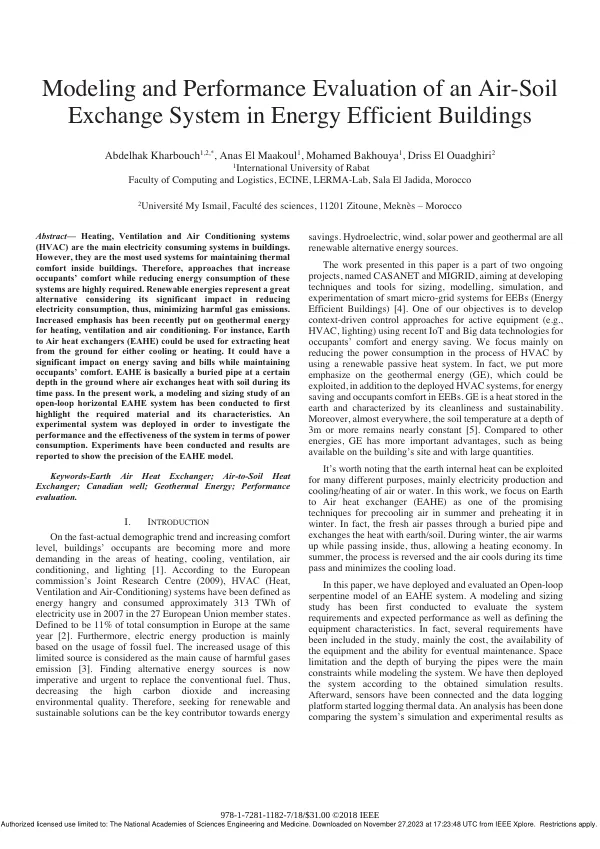
Abstract
This system involves passing fresh air through a buried pipe, where it exchanges heat with the earth or soil. During winter, the air warms up while passing through the pipe, allowing for heating economy. In summer, the process is reversed, and the air cools during its time pass, minimizing the cooling load. The system's performance and effectiveness have been investigated through experiments and simulations. A modeling and sizing study was conducted to evaluate the system's requirements and expected performance, as well as defining the equipment characteristics. The study included several requirements, such as cost, availability of equipment, and ability for eventual maintenance. Space limitation and the depth of burying the pipes were the main constraints while modeling the system. Existing work on earth-to-air heat exchangers (EAHE) has shown promising results in various facilities, including universities, warehouses, and agricultural facilities. EAHE systems have been implemented in several countries, including Germany, Austria, Denmark, Turkey, Algeria, India, and Morocco. These systems have provided significant energy savings and have been widely used in Europe. In Turkey, the first experimental installation of an EAHE system was realized in 2009, with a total design heating capacity of 5 kW. In Algeria, an EAHE system was evaluated under hot and arid climate conditions, and it was found that wet soil increases the efficiency of the system. The performance of EAHE systems has been studied in various climates and conditions. In India, researchers conducted an experimental study to determine the EAHE efficiency for both summer and winter periods. They found that the air temperature drop was 14°C in summer and a significant rise in winter. In Morocco, a Canadian well (EAHE in winter) was deployed in a villa under construction, and the performance coefficient of the system was found to vary between 0 to 5.8 depending on the season, with an average coefficient of 4 in winter. The air-soil exchange system in energy-efficient buildings has shown promising results in reducing energy consumption and improving occupants' comfort. The system's performance and effectiveness have been investigated through experiments and simulations, and existing work on EAHE systems has shown significant energy savings. The system's deployment is still limited on a small scale, but it has the potential to be widely used in energy-efficient buildings. The system's design and deployment involve several components, including the buried pipe, suction fan, and data logging platform. The system's performance is evaluated through thermal data logging and comparison with simulation results. The system's efficiency and gained total power are also evaluated. The results of the experiments and simulations show that the air-soil exchange system in energy-efficient buildings is a promising technique for precooling air in summer and preheating it in winter. The system's performance and effectiveness have been evaluated in various climates and conditions. The results show that the system can provide significant energy savings and improve occupants' comfort. The system's deployment is still limited on a small scale, but it has the potential to be widely used in energy-efficient buildings. The system's design and deployment involve several components, including the buried pipe, suction fan, and data logging platform. The system's performance is evaluated through thermal data logging and comparison with simulation results.