UNITED NATIONS CHILDREN'S FUND
Design Note: Disability Inclusive Education
Disability Inclusive Education in Bangladesh is a critical component of the Primary Education Development Program 4 (PEDP4).
2019 · 43 pages
Sign in to readA free account is required to download.
Abstract
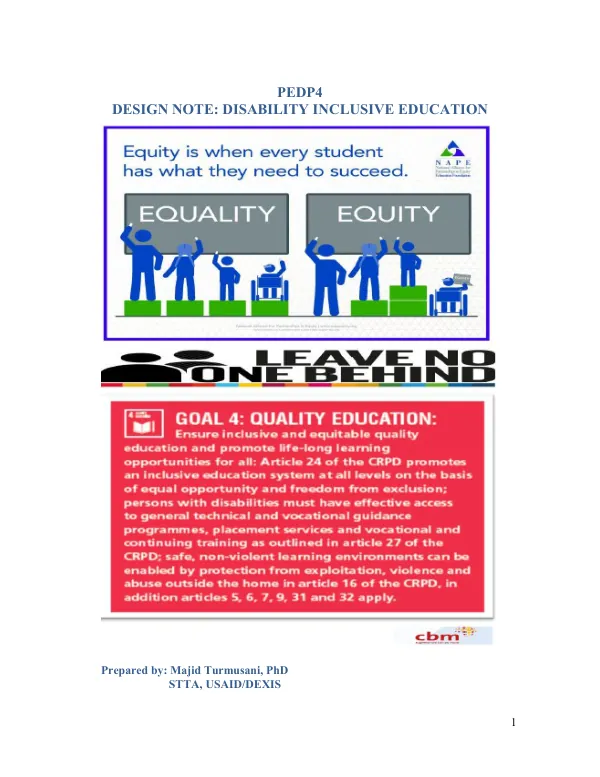
The program aims to reform the primary education system to make it more accommodating to the educational needs of learners with disabilities. A disability inclusion requires a reform in the school system to make it geared towards the specific needs of learners with disabilities, including improved capacity to identify, enroll, maintain, and retain learners with disabilities throughout the primary cycle. The provision of quality education for learners with disabilities requires the recognition of disability as a cross-cutting issue throughout PEDP4 components and sub-components. This includes areas such as gender, language, education in emergency, WASH, school infrastructure, teacher education, curriculum development, and decentralized practices. A shift in perspectives is needed towards learner-centered pedagogy, involving investment in infrastructure, skills, and knowledge, and inclusion practices. Inclusive pedagogy can benefit everyone in the classroom, not just learners with disabilities. The Convention on the Rights of Persons with Disabilities (CRPD) serves as a guiding framework for the program, with Article 24 being a key reference point for measuring progress towards inclusive education for learners with disabilities. The program focuses on changes that need to happen in the education system to improve education outcomes for children with disabilities, including ensuring education spaces adhere to building accessibility standards, facilitating the learning and use of Bangladeshi Sign Language, and integrating differentiated learning into core teacher training programs. Despite the progress made in PEDP2-3, which mainly benefited children with mild disabilities, a reform in the system is needed to accommodate all learners with disabilities. This requires specialized pedagogy for learners with more substantial educational needs, such as those with severe disabilities. The program aims to create an enabling environment, change attitudes of local communities and school authorities, improve school infrastructure, and enhance inclusion practices, including pedagogy, policy, and governance. The program's implementation will be guided by a Results Framework, which outlines key performance indicators and targets for measuring progress. The framework will be used to monitor and evaluate the program's impact and make adjustments as needed. The program's success will depend on the effective implementation of its components and the commitment of stakeholders to creating an inclusive education system that benefits all learners, including those with disabilities.