USAID DEC
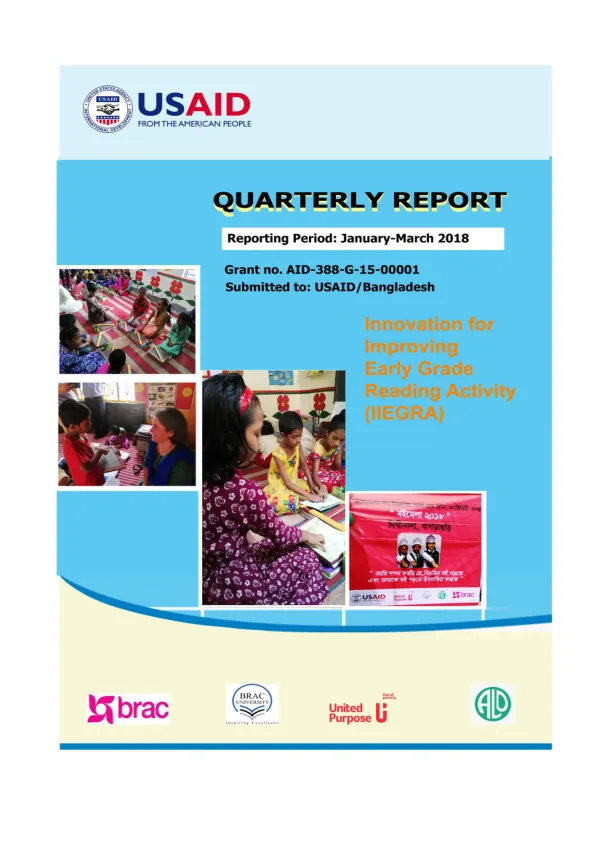
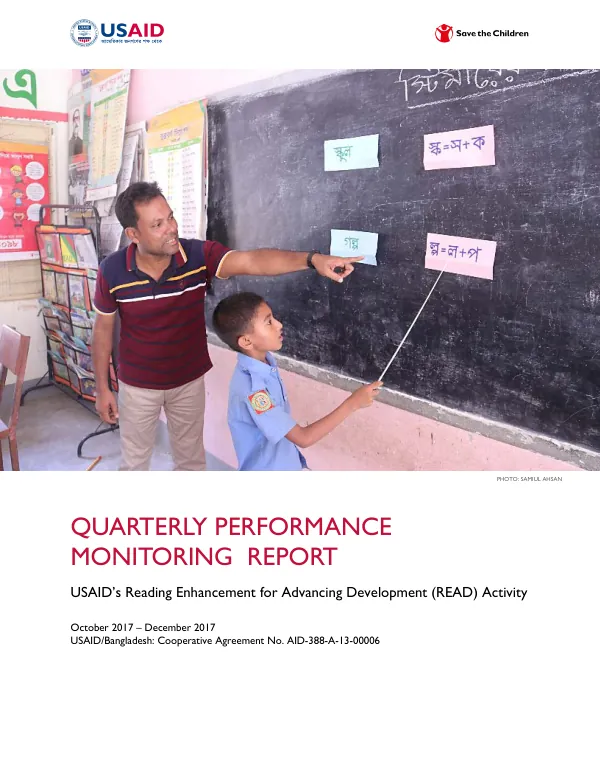
Quarterly Performance Monitoring Report: USAID’s Reading Enhancement for Advancing Development (READ) Activity
Sign inINNOVATIONS FOR POVERTY ACTION
Quarterly Performance Monitoring Report: USAID’s Reading Enhancement for Advancing Development (READ) Activity
The USAID's Reading Enhancement for Advancing Development (READ) project is a unique educational initiative aimed at improving early grade Bangla reading competencies among learners in government primary schools of Bangladesh.
2018 · 45 pages
Sign in to readA free account is required to download.
Abstract
Implemented in collaboration with the Directorate of Primary Education (DPE) since 2013, the project will continue until September 2018. The READ project focuses on enhancing the capacity of teachers to use ICT resources for reading instruction, conducting formative assessments, and providing training to teachers and community literacy volunteers. During the first quarter of Year 5 (October to December 2017), READ provided training to 297 teachers from 297 government primary schools to enhance their capacity to use ICT resources for reading instruction. The project also conducted formative assessments of nearly 162,000 children in Grades 1-3 of 2201 government primary schools under seven divisions of the country. The Instructional Adjustment Tool (IAT) was used to identify children's reading gaps and help teachers take necessary measures to address these gaps. Two major events were conducted during the reporting period. The first event was a result-sharing workshop organized by Beyond Access Bangladesh, a sub-project of READ, in collaboration with the Department of Public Library. The workshop aimed to share successes and lessons learned with the Ministry of Cultural Affairs, National Book Center, Bangladesh Shishu Academy, British Council, and likeminded NGOs. The second event was a project phase-out and learning-sharing workshop held in Khagrachari, which highlighted the learning of READ interventions among Grade I-III children in 45 government primary schools under one Chittagong Hill Track (CHT) district. The program observed significant improvements in children's Bangla reading skills, and district education officials expressed that the learning from the project would be replicated in other areas of CHT. The READ project also added a customized session to community reading camps, focusing on helping non-readers catch up. This strategy will continue until February 2018. Two endline studies were conducted during the reporting period: the CHT Endline Study, led by Innovision Ltd, and the Randomized Control Trial (RCT) Endline Study, led by Innovation for Poverty Action (IPA). The CHT Endline study found significant improvements in all five reading skills for Grades 1-3 students compared to control schools, while the RCT Endline study showed significant improvements in Grade 3 children's reading skills from baseline to endline. However, the READ project faced challenges during the reporting period, including the turnover of Community Literacy Volunteers (CLV) and staff at the field and central levels. The CLVs left due to better-paying opportunities, while staff members dropped out due to job insecurity. The project created a panel for fast recruitment after staff dropouts. The READ project has made significant progress, but there is still scope to improve the quality of the project and the capacity of project staff. The progress report aims to provide an in-depth analysis of all READ interventions implemented during the period of October to December 2017, showcasing achievements, successes, opportunities, challenges, drawbacks, and learning experiences based on the Intermediate Result (IR) of the READ project. The ICT-in-education activities of the READ project focus on enhancing the capacity of teachers to use digital contents for improving early grade Bangla reading skills. The government of Bangladesh is pursuing a proactive policy towards ICT in education, with the Prime Minister's Office, Access to Information (a2i), and the Asian Development Bank (ADB) leading the initiative. The READ project has been working closely with the government to implement this initiative, providing training to teachers and community literacy volunteers on the use of digital contents for improving early grade Bangla reading skills. The ICT Teacher Training program has been instrumental in enhancing the capacity of teachers to use digital contents for reading instruction. The training program has been designed to equip teachers with the skills and knowledge needed to use digital contents effectively in the classroom. The program has been implemented in collaboration with the government and other stakeholders, and has shown significant improvements in children's reading skills. The READ project has also been working closely with the Department of Public Library to implement the ICT-in-education initiative. The project has been providing training to library staff on the use of digital contents for reading instruction, and has been working closely with the library to implement the initiative in schools. The project has been successful in improving children's reading skills, and has shown significant improvements in children's reading skills compared to control schools. The READ project has also been working closely with the National Curriculum and Textbook Board (NCTB) to implement the ICT-in-education initiative. The project has