USAID DEC
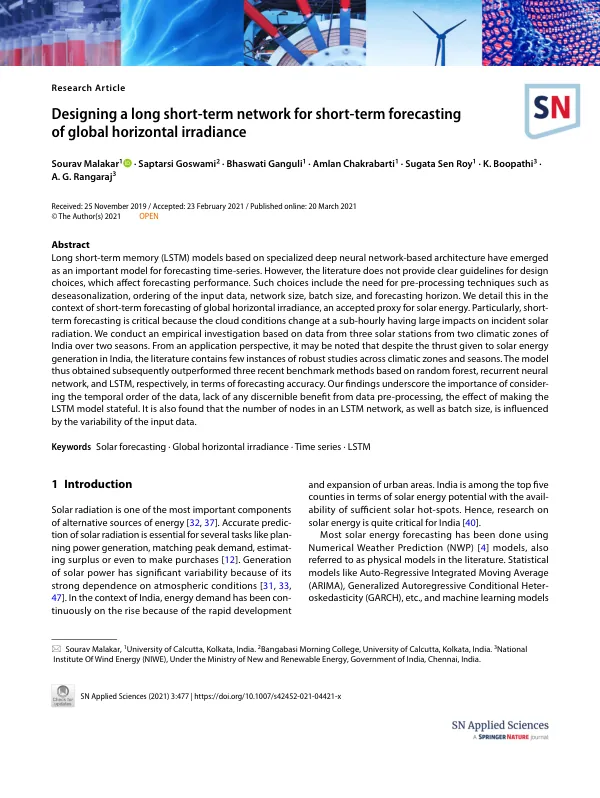
Designing a long short-term network for short-term forecasting of global horizontal irradiance
Sign inUSAID DEC
Designing a long short-term network for short-term forecasting of global horizontal irradiance
Solar radiation is one of the most important components of alternative sources of energy.
2021 · 15 pages
Sign in to readA free account is required to download.
Abstract
Accurate prediction of solar radiation is essential for several tasks like planning power generation, matching peak demand, estimating surplus or even to make purchases. Generation of solar power has significant variability because of its strong dependence on atmospheric conditions. In the context of India, energy demand has been continuously on the rise because of the rapid development and expansion of urban areas. India is among the top five counties in terms of solar energy potential with the availability of sufficient solar hot-spots. Hence, research on solar energy is quite critical for India. Most solar energy forecasting has been done using Numerical Weather Prediction (NWP) models, also referred to as physical models in the literature. Statistical models like Auto-Regressive Integrated Moving Average (ARIMA), Generalized Autoregressive Conditional Heteroskedasticity (GARCH), etc., and machine learning models like Support Vector Regression (SVR), Artificial Neural Network (ANN), etc., have also been used for prediction. Currently, machine learning models have emerged as state-of-the-art solar forecasting models for one to few hours ahead of forecasting. Presently, many of the studies report superior performance exhibited by deep learning models as compared to machine learning models for classification, regression, and time series forecasting. Long short-term memory (LSTM) models based on specialized deep neural network-based architecture have emerged as an important model for forecasting time-series. However, the literature does not provide clear guidelines for design choices, which affect forecasting performance. Such choices include the need for pre-processing techniques such as deserialization, ordering of the input data, network size, batch size, and forecasting horizon. In the context of short-term forecasting of global horizontal irradiance, an accepted proxy for solar energy, the model thus obtained subsequently outperformed three recent benchmark methods based on random forest, recurrent neural network, and LSTM, respectively, in terms of forecasting accuracy. An empirical investigation was conducted based on data from three solar stations from two climatic zones of India over two seasons. The design questions enlisted were empirically evaluated, and important recommendations like considering the temporal order of the data (Non-Supervised setup), no pre-processing, and preserving dependency between batches have been made. It has been established that the forecasting performance is dependent on batch size and variability of the input data. The number of nodes required by the LSTM network increases with an increase in the variability of the input data. The model obtained using these recommendations produces superior forecasting performance applying RF, RNN, and LSTM, respectively. The research efforts have been categorized in terms of the length of the forecasting horizon. In the context of short-term intra-day forecasting of GHI using LSTM, the forecasting performance is dependent on batch size and variability of the input data. The number of nodes required by the LSTM network increases with an increase in the variability of the input data. The model obtained using these recommendations produces superior forecasting performance applying RF, RNN, and LSTM, respectively.