USAID DEC
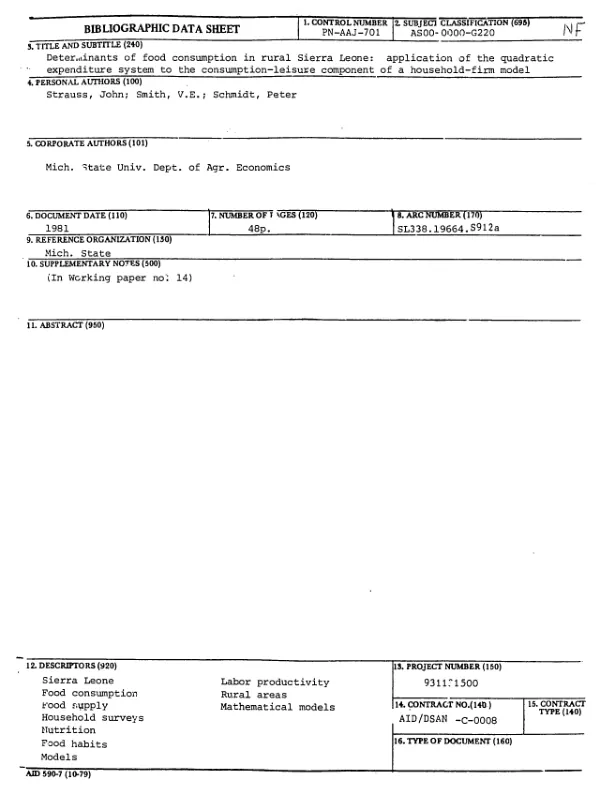
DETERMINANTS OF FOOD CONSUMPTION IN RURAL SIERRA LEONE : APPLICATION OF THE QUADRATIC EXPENDITURE SYSTEM TO THE CONSUMPTION - LEISURE COMPONENT OF A HOUSEHOLD - FIRM MODEL
Sign inMICHIGAN STATE UNIVERSITY. DEPT. OF AGRICULTURAL ECONOMICS
DETERMINANTS OF FOOD CONSUMPTION IN RURAL SIERRA LEONE : APPLICATION OF THE QUADRATIC EXPENDITURE SYSTEM TO THE CONSUMPTION - LEISURE COMPONENT OF A HOUSEHOLD - FIRM MODEL
The unintentional, yet frequent effects of developing country policies on the nutritional well-being of their citizens fall particularly on business people who can adjust outputs, inputs, labor, and consumption in response to price and other socioeconomic variables.
STRAUSS, JOHN; SMITH, VICTOR E. +1 more · 1970
Sign in to readA free account is required to download.
Abstract
This paper reports the estimation of a quadratic expenditure system for a proposed "household-firm" model for measuring allocation of total household resources between consumption and leisure. (The household is treated as a "firm" or business in that account is taken of the effect of socioeconomic variables on household production and labor supply.) The data were gathered from a cross-section of rural households in Sierra Leone during the 1974-75 cropping year. Of significance for development efforts is the general proposition resulting from the study that food demand is responsive to price (except for root crops and other cereals). Price, as an important short-term allocator of food consumption and hence caloric consumption, has been stressed recently by Mellor (1975) and Timmer (1978). Mellor focused on the effect of price on real income, and this study supports his view. However, this study also found, contrary to what was expected, that own-price substitution effects are also important. This was partly due to the commodity disaggregation used (five food groups, including two of staples). Information important to the nutritional planner is also provided. For example, the negative uncompensated effects on root crops with respect to rice price mean that decreases in rice price are not likely to be compensated by increases in cassava consumption; rather, the opposite occurs. Since people shift their production and sales patterns when faced with relative price changes, there is a need to estimate the household-firm model"s production side, something which will be done in future work. Investment in fixed production and human capital variables as well as changes in household size and composition were deemed outside the scope of the study. A list of 54 Michigan State University rural development papers and working papers (1964-80) is appended.