FLORIDA INTERNATIONAL UNIVERSITY
Developing and Using Case Studies
The case study method has been widely used in various disciplines, including business and law, for many years.
2011 · 3 pages
Sign in to readA free account is required to download.
Abstract
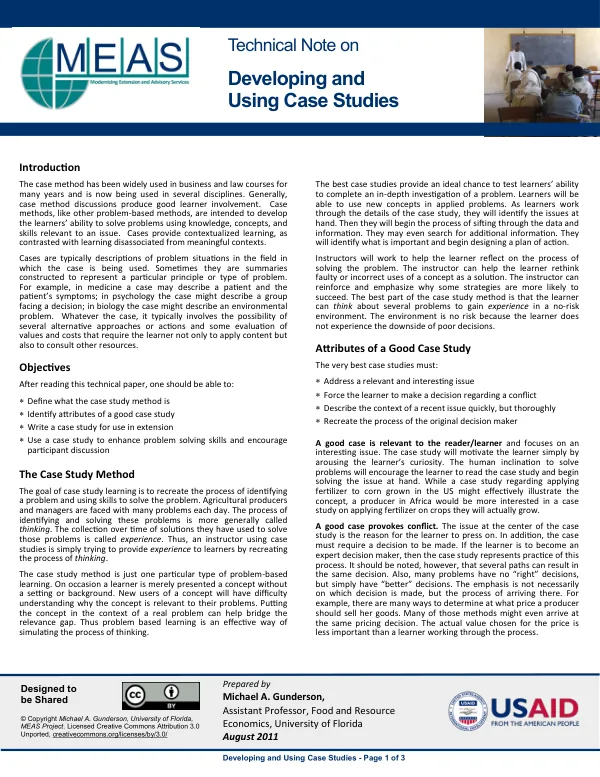
This method is designed to develop learners' ability to solve problems using knowledge, concepts, and skills relevant to an issue. Case studies provide contextualized learning, as opposed to learning that is disassociated from meaningful contexts. They typically involve the possibility of several alternative approaches or actions and some evaluation of values and costs that require the learner to apply content and consult other resources. The primary objective of case study learning is to recreate the process of identifying a problem and using skills to solve it. Agricultural producers and managers face numerous problems daily, and the process of identifying and solving these problems is referred to as thinking. The collection of solutions over time is called experience. An instructor using case studies aims to provide experience to learners by recreating the process of thinking. A good case study should address a relevant and interesting issue, force the learner to make a decision regarding a conflict, and describe the context of a recent issue quickly but thoroughly. The case study should also recreate the process of the original decision maker. A good case study is relevant to the reader/learner and focuses on an interesting issue, motivating the learner by arousing their curiosity. The case study method is just one particular type of problem-based learning. It involves presenting a concept without a setting or background, which can make it difficult for new users to understand its relevance to their problems. By putting the concept in the context of a real problem, the relevance gap can be bridged. This type of learning is effective in simulating the process of thinking. Instructors using case studies aim to help learners reflect on the process of solving the problem. They can help learners rethink faulty or incorrect uses of a concept as a solution and reinforce and emphasize why some strategies are more likely to succeed. The best part of the case study method is that learners can think about several problems to gain experience in a no-risk environment. To write a good case study, the writer must evaluate potential cases, collect data, present the material with the learner and learning setting in mind, and convey the information in a brief, thorough, conversational manner. The writer should consider the audience's background and skill level, as well as the learning setting, when presenting the material. The writer should also strike a balance between brevity and thoroughness, providing enough detail for the learner to understand the process of thinking through the problem. A good case study tells a story about the relevant pieces of information used in making a decision. It should be set in the past five years, though some old cases can effectively illustrate a modern issue. The story should be kept as short as possible, but not so short as to omit important details. The writer of a case must balance length with context carefully, ensuring that the case has some degree of generality and can be applied to other issues. The writer should also create empathy with the central character(s) by including quotations from the main character, photos, and relevant pieces of information used by the decision maker. This will help the learner think through the issue in a way similar to the decision maker.