USAID. BUR. FOR POLICY AND PROGRAM COORDINATION. CENTER FOR DEVELOPMENT INFORMATION AND EVALUATION (CDIE)
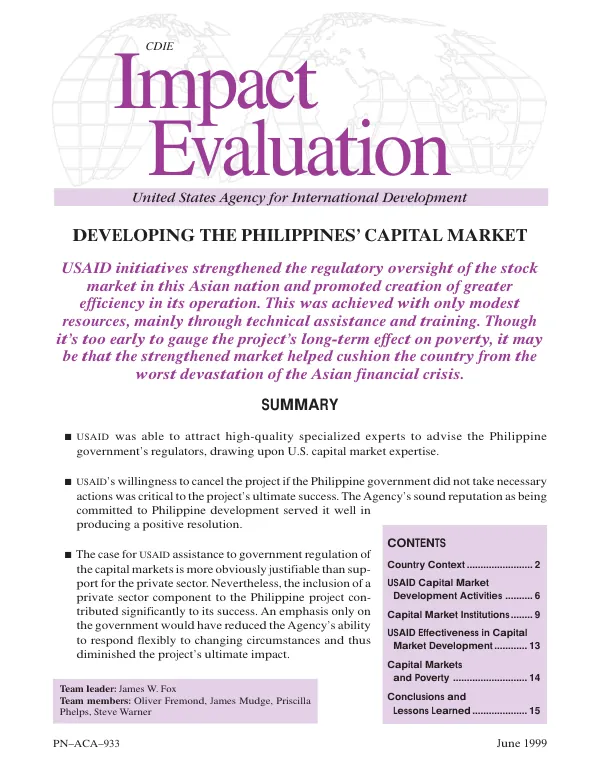
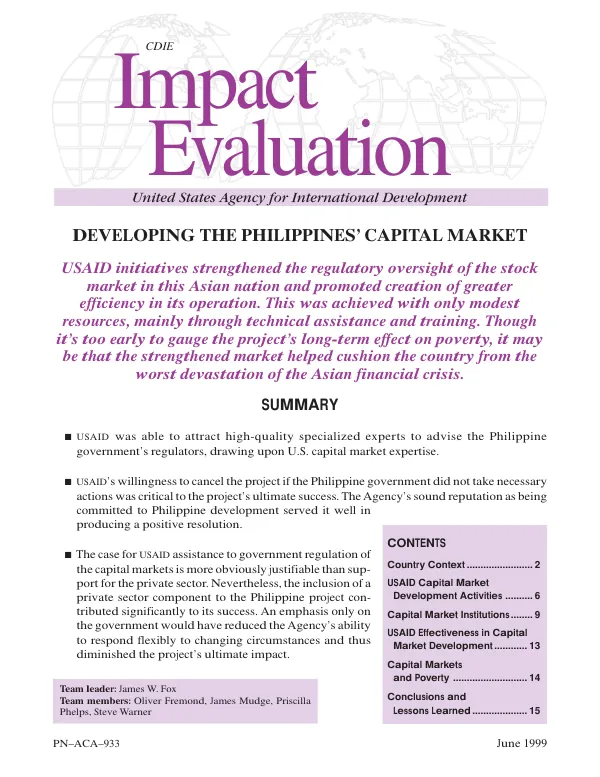
Developing the Philippines" capital market
Part of a series of country studies on the subject, this report assesses the effectiveness of USAID"s assistance for capital market development in the Philippines, largely under the Capital Markets Development Project (4920447 -- 1993-98).
Fox, James W.; Fremond, Oliver · 1999
Sign in to readA free account is required to download.
Abstract
The project featured separate but complementary public and private components. The public sector component was to provide assistance to restructure the Securities and Exchange Commission (SEC). The private sector component was to be managed by an umbrella association of private sector financial institutions, the Financial Executives Institute of the Philippines (FINEX). The project sought to enhance the integrity and capacity of the capital markets to facilitate an increase in the number and types of equity and debt securities. That would, in turn, encourage savings mobilization and increase the quantity and quality of private investment. A separate project provided TA for the privatization of major government-owned companies, leading to their listing on the stock exchange, while another USAID-financed activity helped the Philippine Board of Investment keep American firms informed of the improving environment for foreign portfolio investment in the Philippine market. The Capital Market Development project was a clear success. It contributed substantially to the development of the Philippine capital market both by improving oversight by the SEC and by encouraging a variety of actions to upgrade the operation of the equity market, including the creation of a central securities depository, which permitted scripless trading. USAID acted as a catalyst for change by contributing analyses, encouragement, and pressure to undertake steps to increase the transparency and efficiency of the capital market. USAID clearly sped up the rate at which improvements were made in these markets. In the most extreme case, USAID pressure was instrumental in clearing the way for new leadership for the SEC, an important step in developing the capital market. The combination of public- and private-sector elements in the assistance package contributed to the success of the overall effort. If the project had limited itself to the public sector alone, it would almost certainly have been less successful; it might well have failed entirely. The bond market continues to be underdeveloped, except for national government issues. Passage of the pending capital markets legislation should help somewhat, but the recent macroeconomic instability has postponed the day when interest rates will come down to where long-term corporate debt financing is likely to be an active part of the market. The USAID effort to promote development of a market for municipal bonds is (at best) premature. Most economists oppose granting tax-free status to municipal bonds. Some, though, have argued that it provides a relatively low-cost means for transferring resources from national governments to municipalities. The Agency should develop a position on the desirability of using this tool. With a number of problems still confronting the Philippine capital market, USAID assistance can continue to play an important catalytic role and have a high payoff, at least for several more years. Areas needing attention include: passage of the two pieces of pending legislation on capital markets; further strengthening of the SEC in its core capital market functions; continued efforts to increase protection for investors in publicly traded stocks in areas where the stock exchange is unlikely to take necessary steps on its own; and continued education of market participants, including encouraging the development of new products that can increase market liquidity. (Author abstract, modified)