USAID. BUR. FOR POLICY AND PROGRAM COORDINATION. CENTER FOR DEVELOPMENT INFORMATION AND EVALUATION (CDIE)
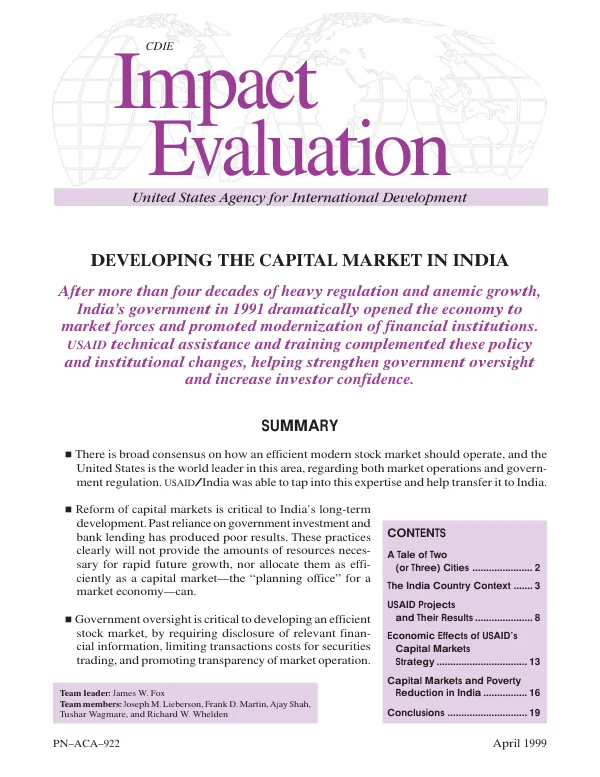
Developing the capital market in India
Since 1985, USAID has financed three programs to support capital market reform in India: the Program for Acceleration of Commercial Technology (PACT), designed to promote external funding for Indian commercial ventures; a series of housing guaranty (HG) programs with India's Housing Development Finance Corporation (HDFC); and the Financial Institutions Reform and Expansion (FIRE) project, designed to support India's 1991 shift to economic liberalization by improving the country's securities markets (regulatory component) and by demonstrating the commercial viability of selected urban infrastructure projects (debt component).
Fox, James W.|Lieberson, Joseph M. · 1999
Sign in to readA free account is required to download.
Abstract
This study examines the impact of these projects. The projects have been very successful. Each project: significantly improved the operation of India's capital markets; experimented with promising activities; pushed the policy environment in a favorable direction; and established or strengthened institutions that have evolved to solve real development problems. PACT helped launch the venture capital industry and demonstrated the value of close collaboration between Indian and U.S. companies at a time when policymakers were skeptical. HDFC provided HG money for housing finance, helping launch the industry, which has since provided billions of dollars of long-term financing for private housing. FIRE/regulatory has increased the transparency of the securities markets and improved oversight by the Securities and Exchange Board, making India more attractive for foreign and domestic investment. FIRE/debt has introduced municipal bonds to finance local infrastructure activities -- an innovative approach that has created great interest. If the many obstacles to its general use can be overcome, it could channel billions of dollars into critically needed urban infrastructure. Other findings include the following: (1) In capital markets, USAID/India has been able to achieve substantial impact and visibility with small projects in a large country. This may be due to the fact that capital markets activity is concentrated geographically and operates with a relatively small number of participants. (2) Despite its lack of specialized knowledge, USAID's staff has been able to manage an activity requiring highly specialized expertise, including excellent technical contractors. (3) Government oversight is critical to developing an efficient stock market, since it requires disclosure of relevant financial information, limits transactions costs for securities trading, and promotes transparency of market operation. Companies are reluctant to disclose financial information, while brokers (who control most stock exchanges) prefer arrangements that make stock transactions non-transparent and high-cost. Disclosure and transparency are also important for avoiding the problems, such as the recent "Asia flu", caused by excessive dependency on foreign financing through loans. Looking to the future, capital markets development is essential to poverty alleviation in India. (Despite USAID's preference for activities having tangible links to poverty alleviation, in India's case, there is simply too much to be done for micro-level activities to make any dent in the problem.) India needs to grow at 8-9% a year in order to eliminate pervasive poverty within a generation. It cannot do this without better capital markets; past reliance on government investment and bank lending has produced poor results. Improving capital markets in India would have two important effects. First, it would increase the quality of investment in the economy. India's economic growth problem in the past half-century has been due more to the quality of national investment than to its quantity. In fact, India would have substantially less poverty today if its government had given more attention to capital markets efficiency and less to directly intervening in the economy, often in the name of poverty alleviation. Second, efficient and transparent capital markets can attract increased foreign savings to India (billions of dollars a year) to finance additional investment in public infrastructure; such investment is essential for both faster economic growth and poverty reduction.