USAID. MISSION TO PHILIPPINES
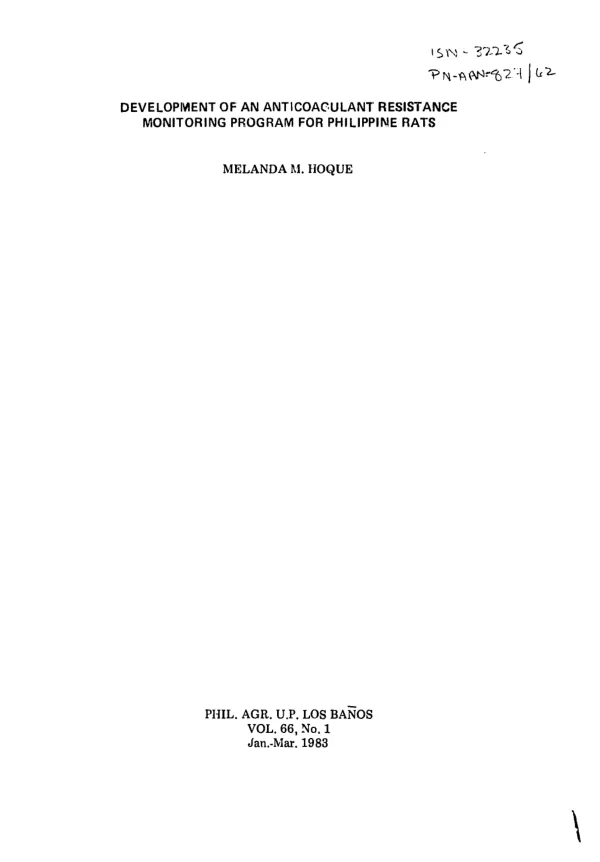
Development of an anticoagulant resistance monitoring program for Philippine rats
Intensive use of anticoagulants for rat control in the Philippines may lead to resistant rat populations as in Europe and the United States.
Hoque, Melanda M. · 1983
Sign in to readA free account is required to download.
Abstract
The study sought to develop a suitable method for screening anticoagulant resistance; a test of compounds known to counter the development of resistant rats elsewhere was conducted on two local Philippine species. A 25-day no-choice feeding test using 0.025% warfarin bait for Rattus rattus mindanensis and a 30-day no-choice feeding test for R. argentiventer were established as a baseline method for future screening of warfarin-resistant rats, should resistance develop in these species. A rat would be considered resistant if it survived 14 days after the treated bait is withdrawn. Tests on bromadiolone at 0.005%, brodifacoum at 0.002%, and warfarin at 0.025% resulted in a similar mean number of days to death (5.6, 6.5, 5.9, respectively). The first two compounds have potential use in the Philippines to kill anticoagulant-resistant rats. (Author abstract, modified)
Connected topics
Related documents
![Impact of trade liberalization on the Philippine economy : a CGE [computable general equilibrium] modeling approach](https://covers.devme.ai/gen/14535.webp)