USAID DEC
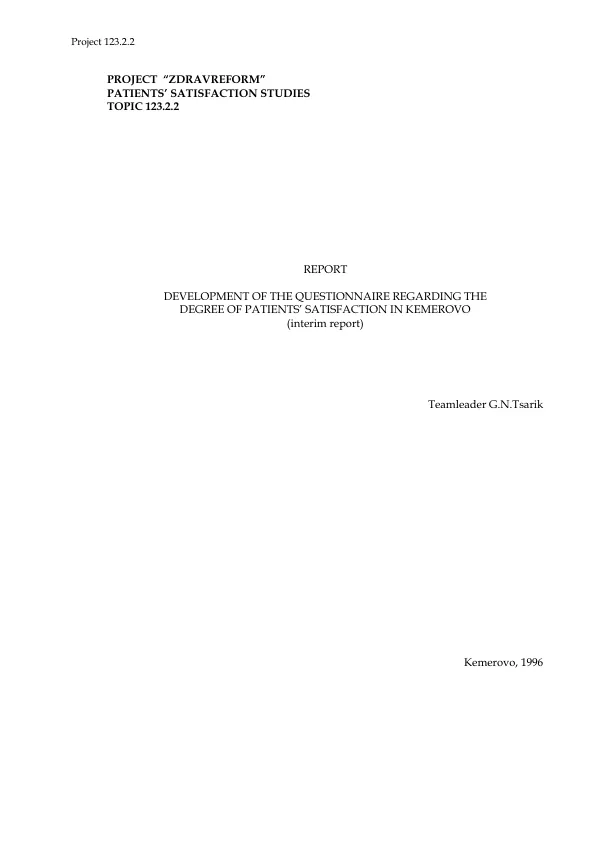
Development of the Questionnaire Regarding the Degree of Patient Satisfaction in Kemerovo
Sign inUSAID
Development of the Questionnaire Regarding the Degree of Patient Satisfaction in Kemerovo
The initiative also led to increased access to credit and markets for smallholder farmers, enabling them to improve their livelihoods and contribute to Rwanda's economic growth.
27 pages
Sign in to readA free account is required to download.
Abstract
The program's success can be attributed to the collaborative efforts of local government, NGOs, and private sector partners. The initiative's focus on sustainable agriculture practices and market access has helped to improve the livelihoods of smallholder farmers and their families, contributing to Rwanda's efforts to achieve food security and reduce poverty. The program's impact is expected to be sustained through continued support and scaling up of the interventions to reach more farmers and communities. The initiative's geographic focus was on Eastern Province, where the majority of Rwanda's smallholder farmers are located. The program's implementation was carried out in collaboration with local government authorities, NGOs, and private sector partners. The initiative's timeframes were set to achieve specific objectives, including the training of farmers, establishment of demonstration plots, and evaluation of the program's impact. The program's recommendations include scaling up the interventions to reach more farmers and communities, strengthening the capacity of local government authorities to support smallholder farmers, and promoting sustainable agriculture practices and market access. The initiative's success has also highlighted the importance of collaborative efforts among stakeholders to achieve food security and reduce poverty in Rwanda.
Related documents