RTI INTERNATIONAL
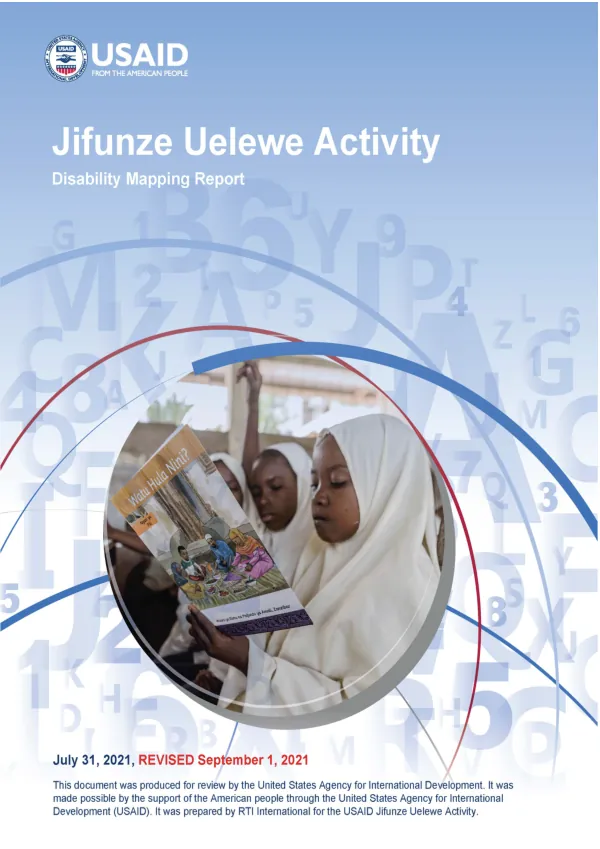
Disability Mapping Report for Jifunze Uelewe Activity
The Jifunze Uelewe Activity is a 4.5-year initiative aimed at improving literacy and numeracy skills for pre-primary through Standard 4 pupils in the regions of Iringa, Morogoro, Mtwara, Ruvuma, and Zanzibar.
2021 · 18 pages
Sign in to readA free account is required to download.
Abstract
The Activity seeks to create safe and inclusive learning environments for all children by 2025. The objective is to ensure that teachers, Head Teachers, and administrators, as well as community-based stakeholders, have the capacity to support government pre-primary and primary schools in the regions. The Activity targets a total of 1,259,227 pupils, including 635,448 boys and 623,779 girls, in 3,133 schools, with 25,578 school teachers, comprising 10,094 men and 15,484 women. The Activity is guided by a results framework with three main outcomes: Improved literacy, numeracy, and social-emotional instruction by teachers; Strengthened capacity of local and regional governments to sustain improved learning outcomes; and Increased community support for safe and inclusive learning environments. The Activity builds on the successes of the USAID's Tusome Pamoja Program and USAID's Hesabu na Elimu Jumuishi Activity by continuing to support early grade education in the same regions. The driving strategy of Jifunze Uelewe is to work through and strengthen the capacity of Government of the United Republic of Tanzania (GOT) and Revolutionary Government of Zanzibar (GOZ) systems and personnel to implement and sustain interventions that lead to improved learning outcomes for all pre-primary through Standard 4 pupils in a safe and inclusive learning environment. The Activity is designed to work through and build the capacity of GOT and GOZ systems and personnel at the local, regional, and national levels to effectively implement and sustain interventions that lead to improved learning outcomes for all pre-primary through Standard 4 pupils in a safe and inclusive learning environment in schools and communities. The Activity will be structured under three main outcomes, with cross-cutting issues of gender responsiveness and incorporating digital strategies and opportunities informing all activities. The Activity's target districts, wards, schools, and pupils and teachers are detailed in Table 1, which provides information on the number of districts, wards, schools, pupils, and teachers in each region. The Activity's results framework is outlined in Table 2, which highlights the overarching Activity objective to sustainably improve Standards 1–4 literacy and numeracy skills for all learners in the targeted regions, as well as create a safe and inclusive learning environment for children from pre-primary through Standard 4 in and outside of schools. The Activity will be implemented through a collaborative approach, with constant coordination with USAID, counterparts from GOT and GOZ, and other key partners. The Activity will be designed to continuously be informed by collaboration, systematic learning, and the adaptation of the Activity's implementation approach through constant coordination with USAID, GOT, and GOZ, and other key partners. The Activity's implementation will be guided by a disability mapping report, which aims to identify the number and types of special education schools, as well as the categories of children with disabilities in the target regions. The report will provide information on the number of schools visited by region, school disability status by region, and disability categories and the number of children with a disability from Iringa, Morogoro, Mtwara, Ruvuma, and Zanzibar. The report will also provide information on children with disabilities by region and sex, screening data conducted under Hesabu na Elimu Jumuishi, and children with disabilities by category, sex, and region from the disability mapping exercise. The report will provide a comprehensive overview of the number and types of special education schools, as well as the categories of children with disabilities in the target regions, which will inform the Activity's implementation and ensure that the needs of children with disabilities are addressed. The Activity's implementation will be guided by a results framework with three main outcomes: Improved literacy, numeracy, and social-emotional instruction by teachers; Strengthened capacity of local and regional governments to sustain improved learning outcomes; and Increased community support for safe and inclusive learning environments. The Activity will be designed to continuously be informed by collaboration, systematic learning, and the adaptation of the Activity's implementation approach through constant coordination with USAID, GOT, and GOZ, and other key partners. The Activity's implementation will be guided by a disability mapping report, which aims to identify the number and types of special education schools
Related documents
Documents in this collection
 2019
2019USAID DEC
USAID Arithmetic and Inclusive Education Activity (AIE) Guide to Minimum Required Characteristics of an Inclusive Learning Environment for Children with Disabilities Reached through AIE
Open record 2016
2016USAID DEC
USAID/Tanzania Tusome Pamoja Program Pre-Primary Inception Report, Draft
Open record