ME&A, INC.
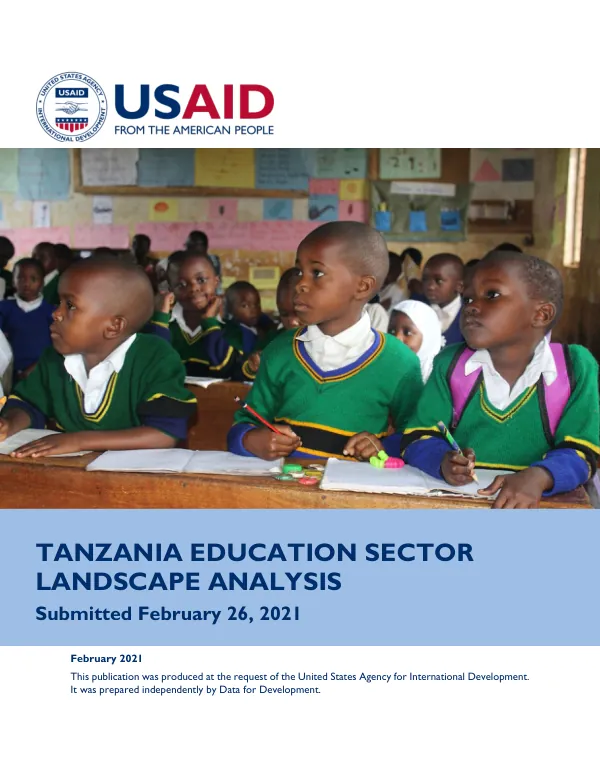
Tanzania Education Sector Landscape Analysis
The Tanzania Education Sector Landscape Analysis was conducted in February 2021 by Data for Development at the request of the United States Agency for International Development.
2021 · 183 pages
Sign in to readA free account is required to download.
Abstract
The analysis aimed to provide an overview of the education sector in Tanzania, including the government's approach to education, the current state of education, and donor funding profiles. The government's approach to education in Tanzania is focused on increasing access to quality education, particularly for marginalized groups. The Ministry of Education, Science, and Technology (MOEST) and the Ministry of Education, Vocational Training, and Research (MOEVT) have identified key priorities, including equitable access to quality education, improving the quality of education, and increasing access to education for marginalized groups. The current state of education in Tanzania is characterized by a number of challenges, including a shortage of trained teachers, inadequate infrastructure, and limited access to education for marginalized groups. The demographic profile of children and school-aged youth in Tanzania shows that there are significant disparities in access to education, with girls and children from marginalized groups facing particular barriers. The analysis also examined the impact of COVID-19 on the education sector in Tanzania. The pandemic has had a significant impact on the education sector, with schools closed for extended periods and many students unable to access education. The government has implemented a number of measures to mitigate the impact of the pandemic, including the use of digital technologies to deliver education. The analysis identified a number of opportunities for improved complementarity among major education donors in Tanzania. The donors have different implementation schemes, but there are opportunities for collaboration and coordination to improve the effectiveness of their programs. The analysis also highlighted the specific gender gaps and barriers that prohibit girls from attaining equal education and, as a result, employment and improved livelihood opportunities. The barriers include limited access to education, particularly in rural areas, and a lack of support for girls to pursue education and careers. The analysis concluded that supply-side programming could help address sector improvement needs, including increasing the number of trained teachers and improving the quality of education. Demand-side programming could also help address sector improvement needs, including increasing access to education for marginalized groups and improving the quality of education. The analysis was conducted using a range of methods, including literature reviews, interviews with stakeholders, and data analysis. The analysis was limited by the availability of data and the complexity of the education sector in Tanzania. The Tanzania Education Sector Landscape Analysis provides a comprehensive overview of the education sector in Tanzania, including the government's approach to education, the current state of education, and donor funding profiles. The analysis highlights the challenges facing the education sector in Tanzania, including a shortage of trained teachers, inadequate infrastructure, and limited access to education for marginalized groups. The analysis also identifies opportunities for improved complementarity among major education donors in Tanzania and highlights the specific gender gaps and barriers that prohibit girls from attaining equal education and, as a result, employment and improved livelihood opportunities. The analysis provides a number of recommendations for improving the education sector in Tanzania, including increasing the number of trained teachers, improving the quality of education, and increasing access to education for marginalized groups. The analysis also recommends that donors work together to improve the effectiveness of their programs and that the government prioritize the needs of marginalized groups in its education policies. The analysis was conducted by a team of experts from Data for Development, including Jen Steele, Godfrey Telli, Aikande Kwaiyu, Letitia Onyango, Jacob Laden, Nasson Konga, Bahati Tenga, Saimon Venance, and Ephraim Danford. The analysis was submitted to the United States Agency for International Development on February 26, 2021, and revised on April 2, 2021.
Related documents