USAID DEC
Discover Wadi El Gemal National Park Sites of Interest from the Mountains to the Sea
Sign inUSAID DEC
Discover Wadi El Gemal National Park Sites of Interest from the Mountains to the Sea
Wadi El Gemal National Park is a significant site of interest in the Eastern Desert, spanning from the mountains to the sea.
2 pages
Sign in to readA free account is required to download.
Abstract
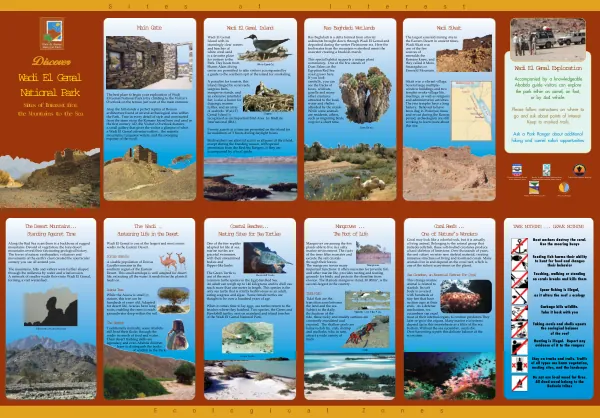
The park's main gate serves as the starting point for exploration, where visitors can climb to the Visitor's Overlook, a replica of Roman architecture, to gain a panoramic view of the park's majestic mountains, turquoise waters, and sweeping expanse of the wadi. One of the park's notable features is Wadi El Gemal Island, a haven for marine life, including marine turtles, dugongs, and seabirds. The island is recognized as an Important Bird Area by BirdLife International and is home to a diverse array of flora and fauna. Visitors are permitted to access the island for snorkeling and birdwatching, accompanied by a local guide. The park's coastal beaches serve as nesting sites for sea turtles, including the Green Turtle and Hawksbill Turtle. These turtles are adapted to life at sea, with streamlined bodies and flipper-like limbs, and can weigh up to 140 kilograms and reach over one meter in length. The park's coral reefs are also home to a variety of marine life, including the sea cucumber, an essential partner for coral health. The park's desert mountains reveal their fascinating geological history, shaped by the forces of nature, including earthquakes, volcanoes, and movements of the earth's crust. The mountains, hills, and valleys were further shaped through the millennia by water and wind erosion, creating a vast watershed. The park's unique landscape supports a diverse array of flora and fauna, including the Dorcas Gazelle, a small antelope well adapted for desert life. Wadi Sikait, one of the largest emerald mining sites in the Eastern Desert in ancient times, is a significant archaeological site within the park. The site features several large multiple-window buildings and two temples, believed to have been dug in Ptolemaic times and re-cut during the Roman period. The park's Ababda guides offer visitors the opportunity to explore the park on camel, on foot, or by 4x4 vehicle, while following marked trails and respecting the park's unique ecosystem. The park's mangrove stands, including the second-largest in the country, offer nurseries for juvenile fish and other marine life, provide nesting and feeding grounds for birds, and protect the shoreline from erosion. The tidal flats, subject to daily fluctuations of the tide, are home to a wide variety of birds and marine life. The park's unique ecosystem supports a diverse array of flora and fauna, including the Hamata mangrove stand, which is a vital component of the park's ecosystem. The park's Ras Baghdadi Wetlands, a delta formed from alluvial sediments, support a unique plant community, including the Dom Palms, one of the few stands on the Egyptian Red Sea coast. The wetlands provide a habitat for a variety of animals, including foxes, wildcats, and gazelle, and are an important stopover for migrating birds. The park's conservation efforts are supported by the Red Sea Rangers, Nature Conservation Sector, Ministry of State for Environmental Affairs, Egyptian Environmental Affairs Agency, and Tourism Development Authority. The park's unique ecosystem and diverse array of flora and fauna make it an important site for conservation and research.