USAID DEC
End-of-Term Evaluation of SITE: Cultural Heritage Tourism in Egypt and Memphis, Egypt’s Ancient Capital: A Plan for Site and Community Development
Sign inTHE QED GROUP, LLC
End-of-Term Evaluation of SITE: Cultural Heritage Tourism in Egypt and Memphis, Egypt’s Ancient Capital: A Plan for Site and Community Development
The Sustainable Investment in Tourism in Egypt (SITE) project aimed to increase the competitiveness of the Egyptian tourism sector while providing employment during the country's downturn in tourism arrivals.
2018 · 15 pages
Sign in to readA free account is required to download.
Abstract
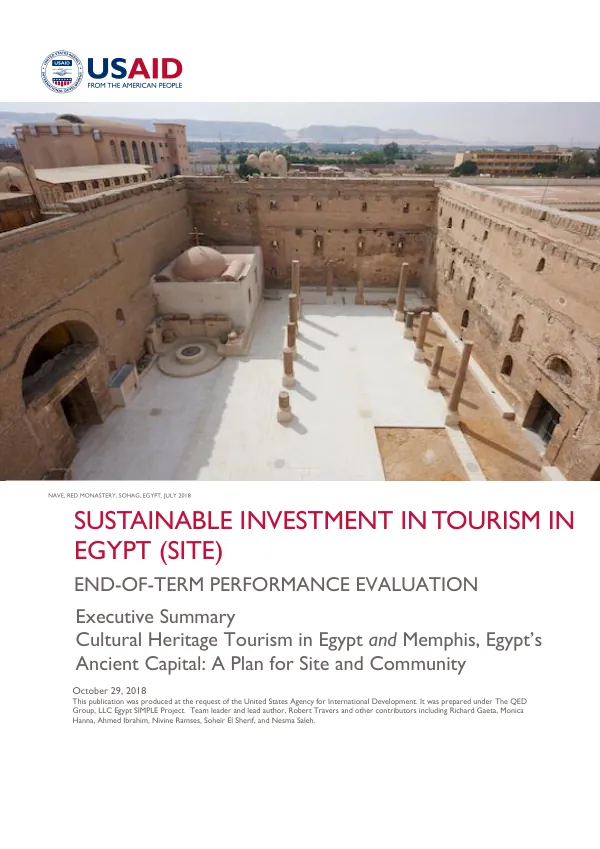
The project was implemented by the American Research Center in Egypt (ARCE) and Ancient Egypt Research Associates (AERA) under the USAID-funded Cultural Heritage Tourism in Egypt (CHTE) and Memphis, Egypt's Ancient Capital: A Plan for Site and Community Development (MSCD) projects. The CHTE project, implemented by ARCE, focused on the conservation and restoration of several archaeological sites in Egypt, including the Red Monastery in Sohag and the Khonsu Temple chapel murals in Luxor. The project involved the removal of rubble, construction of a paved ramp/stairway for improved visitor access, and the creation of shaded seating areas for tourist relief. The project also improved the visual and security environment in parts of the West Bank and conserved and made accessible three tombs for possible public viewing. The MSCD project, implemented by AERA, focused on the development of a plan for site and community development in Memphis, Egypt's ancient capital. The project involved the restoration of the Red Monastery nave and its adjoining tower, as well as the creation of a flexible space for religious, community, and possible tourism use. The evaluation of the CHTE and MSCD projects found that the physical changes at the archaeological sites were significant, with the most notable changes observed in Dra Abu 'l-Naga. The evaluation also found that the extent of project consultations was insufficient, with limited engagement with tourism concerns and local communities. However, the evaluation noted that the restoration under the CHTE project at the Red Monastery was robust and repurposed the area as a courtyard where visitors can gather and religious services can take place. The evaluation made several recommendations, including the need for a memorandum of agreement between the Ministry of Antiquities (MOA) and prospective implementing partners to be drawn up for similar future projects. The evaluation also noted that some of the conservation procedures at Khonsu Temple and the Theban Necropolis tombs were not in accordance with current international best practices. The evaluation found that the CHTE project had a positive impact on the cultural tourism potential of the sites, with the newly cleaned murals at Khonsu Temple providing a significant additional attraction within the highly visited Karnack complex. However, the evaluation noted that the project's impact on job creation and economic development was limited due to the project's focus on conservation and restoration rather than economic development. Overall, the evaluation of the CHTE and MSCD projects found that the projects had a positive impact on the cultural tourism potential of the sites, but that the extent of project consultations was insufficient and that some of the conservation procedures were not in accordance with current international best practices. The evaluation made several recommendations for future projects, including the need for a memorandum of agreement between the MOA and prospective implementing partners.