USAID. MISSION TO TANZANIA
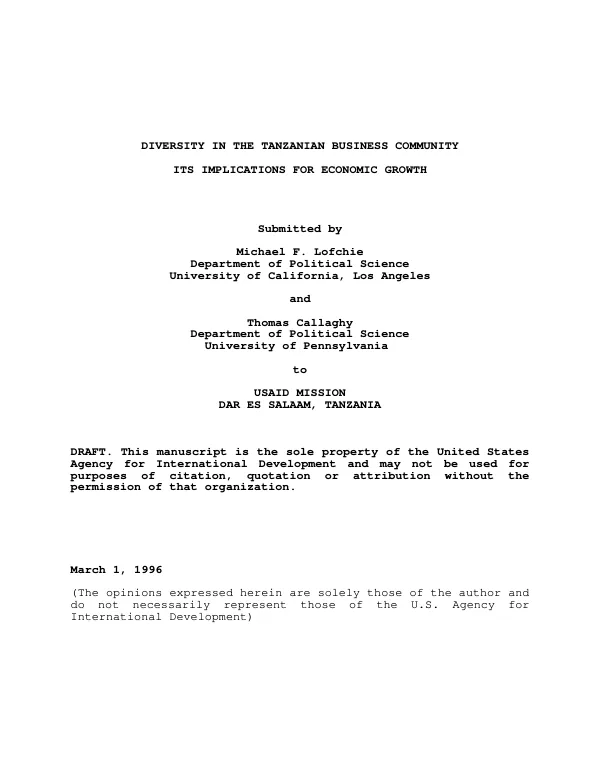
Diversity in the Tanzanian business community : its implication for economic growth
Despite a decade of economic reforms, Tanzania"s business environment remains risky.
Lofchie, Michael F.; Callaghy, Thomas · 1996
Sign in to readA free account is required to download.
Abstract
This report profiles the diversity of Tanzanian businesses and the difficulties they face, and assesses prospects for future economic growth. The difficulties of Tanzania"s business environment are numerous and include the following. (1) Businesspeople believe that portions of the bureaucracy continue to exhibit the laxity and indifference to performance of the socialist era, and are still inclined toward a statist approach to economic management. (2) Corruption raises the costs of doing business and thereby imposes an implicit tax on all Tanzanians. It transfers economic resources from public sector institutions, such as schools and hospitals, to political leaders and civil servants in their capacity as private citizens. It has also led to public cynicism and donor fatigue. (3) Business is constrained by poor infrastructure such as inadequate telephone communications and irregular and unpredictable electricity and water services. (4) Business leaders feel that they have little or no leverage over a government whose actions can spell the difference between economic success and failure. (5) The party system does not present the business community with a supportable alternative to the present government. (6) The business community has a vast agenda in rebuilding organizational and entrepreneurial skills lost during the socialist period. (7) Property rights in productive assets are poorly spelled out and the continuation of repressive laws from the socialist period exerts a chilling effect. (8) Credit is difficult to obtain and available only at high interest rates. Government bonds paying 40-50% "crowd out" private borrowing. Diversity in Tanzanian business assumes several distinct forms. Some businesses which survived during the socialist era are now dying out because of the new economic environment and the flood of imports; new businesses able to thrive in a competitive environment are replacing them. Traders and manufacturers have diametrically opposed economic interests: manufacturers seek protection and have formed the Confederation of Tanzanian Industries (CTI) to try to obtain it but have been unsuccessful; traders seek freedom to import; they have prevailed. Owing to poor customs enforcement, Tanzania is a virtual duty-free zone. The report explores the stereotype that Asians: concentrate in trade; avoid investments in fixed assets; corrupt the political system to the detriment of African welfare; and have an unfair advantage over indigenous business. It concludes that: overt racial antagonism toward Asians based on these beliefs has begun to decline; individual Asians have invested heavily in fixed assets, including factories and plantations, and this fact is becoming widely known and better appreciated; many Africans have an empathic understanding of the repeated traumas inflicted upon Asians in the past; and the CCM (Chama Cha Mapinduzi, the Revolutionary Party) has employed its moral suasion to create a non-racial political climate. Asian entrepreneurs acknowledge problems of corruption but raise serious issues: that the very concept of Asian is problematic when applied to families that have lived in Tanzania for generations; that cases of corruption are confined to a small minority, some of whom are recent arrivals or returnees; that collective responsibility is not an appropriate conclusion; that blame should be assigned to the recipient as well as giver of bribes; that business intrinsically prefers a predictable, law-abiding environment; that hedging strategies which keep assets overseas are a rational response to the insecure environment and not a culturally determined phenomenon. Other aspects of diversity considered in this report are: the growing importance of multinational enterprise; the division between formal and informal sector activities; and the gender gap between female-owned and male-owned enterprises. The report concludes by assessing Tanzania"s politico-economic future. It finds two possible scenarios: reinvigorated and stalled reform. The difference hangs on whether Mkapa is seen as an independent leader, one not tied to Nyerere, who has the strength and will to relaunch the reform effort by taking some very tough decisions early on and making sure that they are carefully implemented; or as honest and well meaning, but too tied to Nyerere and other barons of the party to provide strong, visible leadership and a vision of some form of a new capitalist future. (Author abstract)