USAID DEC
Does schooling make a better farmer? : schooling and agricultural productivity in Burundi
Sign inHARVARD UNIVERSITY. HARVARD GRADUATE SCHOOL OF EDUCATION
Does schooling make a better farmer? : schooling and agricultural productivity in Burundi
Does schooling increase the productivity of Burundi farmers?
Eisemon, Thomas Owen; Prouty, Robert +1 more · 1989
Sign in to readA free account is required to download.
Abstract
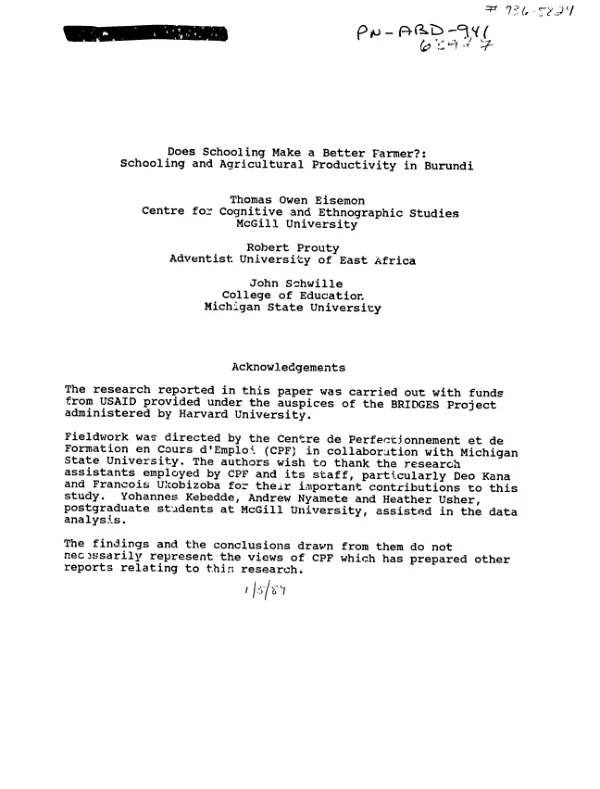
To answer this question, this paper examines agricultural instruction in primary schools in Burundi, and assesses the impact that the teaching has had on the way school leavers think about and practice agriculture. After reviewing colonial strategies and post-independence reforms (particularly those made in 1973), the study describes the teaching of agriculture and science in primary schools, the use of school gardens for practical training, and the effects that enrollment expansion and selection for secondary education have had on student instruction. Findings are presented from surveys of sixth grade students in three primary schools and of farmers living in the school catchment areas. While schooling is found to have a modest impact on agricultural productivity (especially for food crops), research suggests that schooling does little more than reinforce what students learn outside the classroom. Therefore, to improve this situation, the paper argues that changes are needed in educational policy as well as in instructional methods. Key recommendations include: (1) linking the functions of agricultural education and extension; (2) integrating the teaching of science, agriculture, and nutrition; (3) expanding the use of Kirundi, the vernacular language, as a medium of instruction; and (4) integrating agricultural subjects into the concours national, the test given at the end of the primary cycle for admission into secondary schools. Farmers throughout Africa are being increasingly exposed to new agricultural technologies; primary schools should recognize this fact by giving students a basic knowledge of the natural world to help them assimilate modern agricultural practices.