U.S. DEPT. OF THE INTERIOR. NATIONAL PARK SERVICE
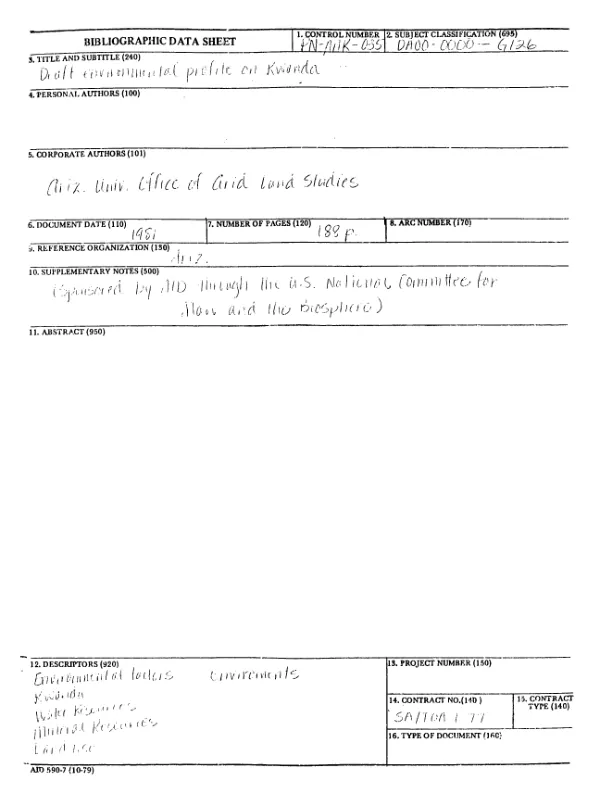
Draft environmental profile on Rwanda
With its rapid population growth and limited natural resources, Rwanda faces a number of serious environmental problems according to this draft report on the country"s geography, climate, demography, geology, mineral and energy resources, soils, water resources, and flora and fauna.
1981
Sign in to readA free account is required to download.
Abstract
Rwanda has a diverse but fragile tropical ecology and its climate and rainfall are adequate for two growing seasons. However, Rwanda"s landlocked location, total dependence on agriculture, and lack of mineral resources adversely affect development efforts. Six environmental problem areas are noted: (1) Rwanda"s population, already the densest in Africa, will occupy all arable land by 2000. The absence of modern agricultural techniques and the lack of urban employment opportunities increase the pressure on agricultural lands. (2) Rwanda"s forests function as a climatic regulator and are essential to rainfall catchment. The removal of trees for farm land, fuel, and construction places an intolerable burden on forest preserves. Large-scale reforestation efforts and the development of alternate fuel sources are badly needed. (3) Animals are excessive in number, suffer from malnutrition and disease, and are of low productivity. Overgrazing results in the loss of quality grasses and leaves pasture land vulnerable to indiscriminate burning. Improved programs of herd management must be undertaken on a larger scale. (4) Deforestation, overgrazing, and traditional cropping practices threaten the fertility of Rwanda"s fragile soils and cause extensive erosion. Pilot programs of ecologically oriented agriculture have been very limited in scope. (5) Malaria, measles, contaminated water, and chronic malnutrition affect most Rwandese. Swamp clearance, irrigation, and reforestation projects are likely to worsen these health problems by extending the environments suitable to disease-carrying vectors. (6) Several rare and endangered species are threatened with extinction in Rwanda"s two national parks because a lack of funds and personnel make it difficult to control encroachment and poaching. Appendices include extensive floral and faunal surveys, a summary of environmental law, a review of related A.I.D. projects, and a 227-item (1956-81) French and English bibliography.
Related documents