JAPANESE AGENCY FOR INTERNATIONAL COOPERATION
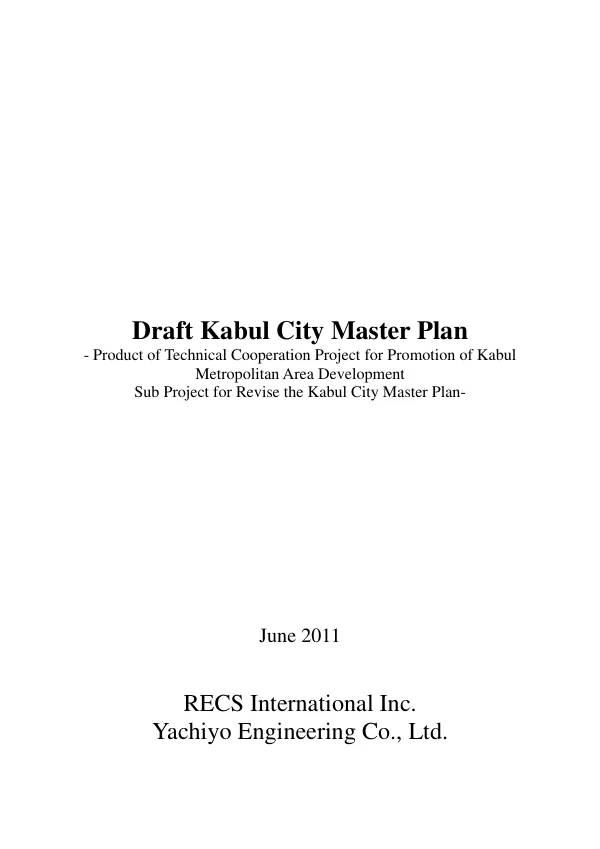
Draft Kabul City Master Plan
The Kabul City Master Plan is a comprehensive document outlining the development strategy for the city of Kabul, Afghanistan.
2011 · 334 pages
Sign in to readA free account is required to download.
Abstract
The plan was prepared by a team of experts from Japan International Cooperation Agency (JICA) and the Kabul Municipality, with the objective of promoting sustainable development in the city. The plan begins by providing an overview of the existing conditions of Kabul City, including its location, access, natural settings, socio-economic conditions, and past disasters. The city is situated in the eastern part of Afghanistan, with a population of over 3.5 million people. The city's natural settings are characterized by a river basin, with a mix of mountains, valleys, and plains. The climate is temperate, with cold winters and hot summers. The socio-economic conditions of Kabul City are marked by rapid urbanization, with a growth rate of 4.5% per annum. The city's population is projected to reach 5.5 million by 2025, with a significant increase in the number of households and employment opportunities. The city's economy is primarily driven by the service sector, with a growing informal sector. The plan identifies several factors that will affect the development directions for Kabul City, including urbanization pressure, available land resource, and available water resources. The plan proposes a direction of urban development for Kabul City, based on a compact and connected urban model, with a focus on preserving the city's natural and cultural heritage. The land use plan and land development strategy are key components of the master plan. The plan proposes a procedure for land use planning, which involves the identification of land use categories, such as residential, commercial, industrial, and public facilities. The plan also proposes a land development strategy, which includes the development of business and commercial areas, housing areas, industrial land, parks and open spaces, and public facilities. The transport infrastructure development plan is another critical component of the master plan. The plan provides an overview of the existing condition of urban transport infrastructure in Kabul City, including the road network, public transport, and ongoing and planned projects. The plan proposes a road traffic characteristics study, which will provide a detailed analysis of the city's road network and traffic patterns. The plan also proposes a development framework for Kabul City, which includes a population framework and distribution by water basin toward 2025, and an employment and macro-economy framework. The plan aims to promote sustainable development in the city, with a focus on preserving the city's natural and cultural heritage, and improving the quality of life for its citizens. The master plan is a comprehensive document that provides a framework for the development of Kabul City. It outlines the city's development strategy, land use plan, and transport infrastructure development plan, and provides a roadmap for the city's future development. The plan is expected to contribute to the enhancement of friendly relationship between Japan and Afghanistan, and to promote sustainable development in the city of Kabul.
Related documents