USAID. MISSION TO BELIZE
Drug awareness and education
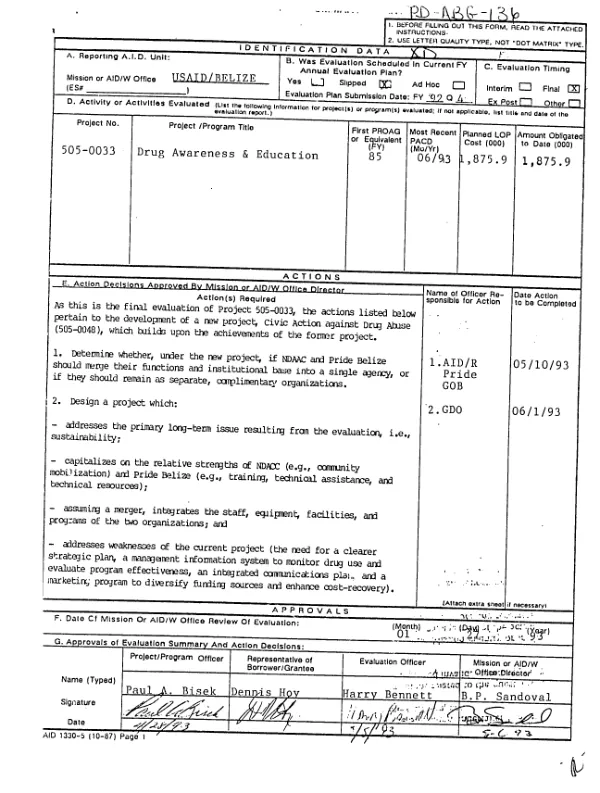
Summarizes final evaluation, focusing on Phase IV, of a project (1985-6/93) to promote a drug-free lifestyle in Belize through the National Parents" Resource Institute for Drug Education (PRIDE), a PVO.
1993
Sign in to readA free account is required to download.
Abstract
The primary purpose of the evaluation was to provide direction for designing a follow-on project, "Civic Action Against Drug Abuse" (5050048). Overall, the project achieved its major objectives. PRIDE has been most effective as a training and technical resource center for other programs in the field, and least effective in directly delivering community-level services. Its training-of-trainers approach, developed by networking with the public-sector National Drug Abuse Control Council (NDACC), has enabled it to maximize its limited human resources. This training-of-trainers/networking approach has also proven effective in other USAID-supported drug prevention programs. Training activities and other interpersonal communications have reached several thousand individuals (with approximately 12,000 personal contacts) over the past 2 years; student and employee assistance programs have also been created. In addition, PRIDE has undertaken a national drug prevalence survey on its own and has kept awareness of the drug abuse problem alive among important target audiences such as educators, schoolchildren, and opinion leaders. Some objectives were not achieved. PRIDE failed to hire a qualified researcher, and was unable to undertake the required number of studies or to develop an adequate impact evaluation program. Also, PRIDE"s media effort is not of optimal quality, nor is it well-coordinated. Although PRIDE is an effective agency and a valuable resource to allied programs, it does not appear to be sustainable without continued USAID support. It is also clear that sources of funding for drug prevention activities in Belize are becoming increasingly limited. PRIDE and the NDACC should consider gradually merging into a single governmental or quasi-governmental agency. Alternatively, if they continue as separate, complementary agencies, they should jointly seek and appropriately divide the resources from their major donors, with PRIDE focusing on marketing prevention services to the private sector.
Related documents