USAID DEC
Project assistance completion report : drug awareness education (DAE) project no. 505-0033
Sign inUSAID. MISSION TO BELIZE
Project assistance completion report : drug awareness education (DAE) project no. 505-0033
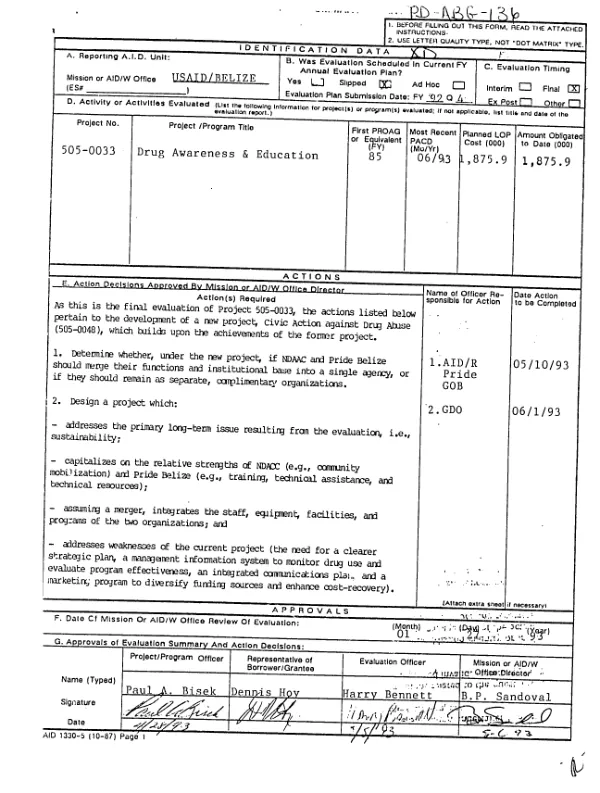
PACR of a project (9/85-6/93) to implement a drug awareness and education program in Belize.
Leacock, Carolyn · 1994
Sign in to readA free account is required to download.
Abstract
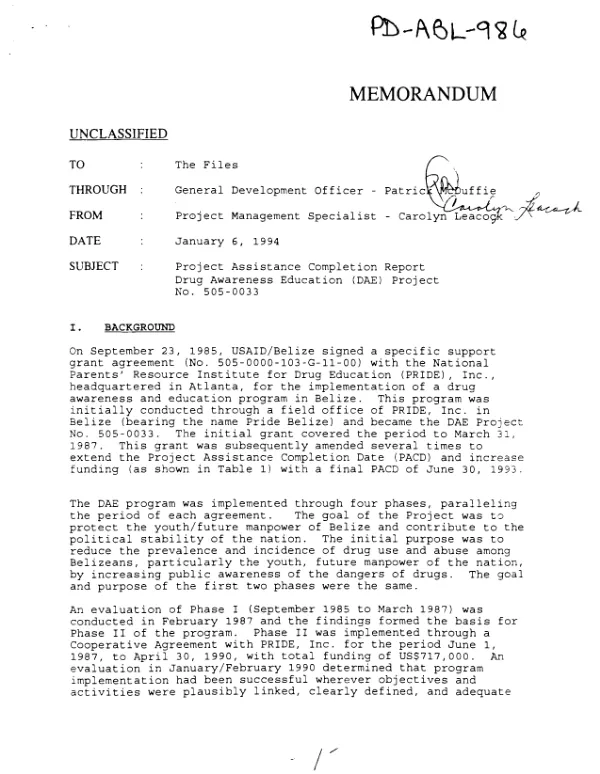
A key project objective was the development of PRIDE/Belize as an indigenous PVO independent of the project grantee, the Atlanta-based National Parents' Resource Institute for Drug Education (PRIDE). Overall, the project succeeded in meeting its objectives. PRIDE/Belize is now a fully functioning PVO which provides training and TA support in a variety of fields related to drug awareness and education. It is a recognized leader in this field, serving as a catalyst for many drug demand reduction activities and initiatives in Belize. Through its newsletters, literature reviews, media program, drug surveys, it keeps the public aware of the extent of the drug problem in Belize and knowledgeable about the dangers of drug use. It is not, however, financially sustainable at this time. The planned output of increasing and subsequently maintaining awareness and knowledge of drug use among students and the general public was achieved. However, behavioral changes have not necessarily resulted. A 6/93 household survey revealed that drug use (specifically, of crack/cocaine) among Belizians in urban centers far surpasses the highest levels reported elsewhere in Latin America and Caribbean countries. The information dissemination output was substantially achieved. Efforts included three school drug surveys, national- and electoral district-level household/community awareness drug surveys, and a national mass media campaign. However, provision of reliable and useful information on the extent of the drug problem in Belize has been hindered by the absence of an effective management information system. In addition, the mass media program lacked a clear social marketing thrust matching messages with specific consumers. Changes in values, attitudes, and policies can be measured through the project's effects on other bodies and organizations. Several private businesses, as well as the public service, are known to have instituted drug use related programs and policies during the last phase of the project. PRIDE/Belize was the primary force in the establishment in 1990 of a National Drug Abuse Control Foundation having a legislative mandate for drug demand reduction. Significant developments in rehabilitation (e.g., the creation of Addiction Alert), have paralleled PRIDE/Belize's focus on drug awareness and education. Finally, PRIDE/Belize has successfully provided services, training, and dug education at all levels of the educational system and is now promoting establishment of a standard counseling/drug policy for use nationwide. Lessons learned include the following. (1) The development challenge presented by drug abuse must be combated by an explicit and coordinated strategy implemented by public and private sector agencies with full support at the community level (schools, parents, peers, and media). (2) Community action is fundamental to effecting change in drug use prevalence and patterns among youth. (3) An NGO in Belize or any other country whose primary mission is drug prevention is not likely to be financially sustainable without support from the communities it serves, donors, government, and other sources. (4) It is essential that program planning and evaluation be based on reliable and accurate data/information on the extent of the drug problem.
Related documents