USAID DEC
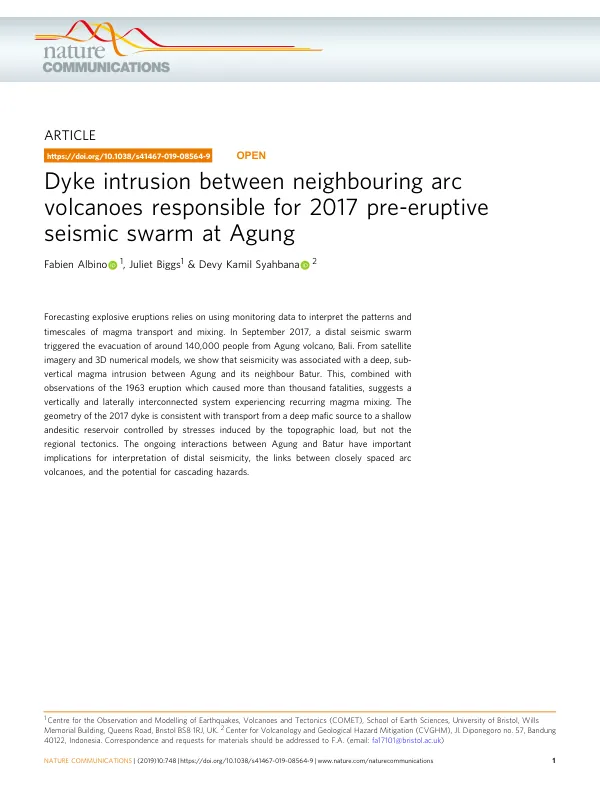
Dyke intrusion between neighbouring arc volcanoes responsible for 2017 pre-eruptive seismic swarm at Agung
Sign inUSAID DEC
Dyke intrusion between neighbouring arc volcanoes responsible for 2017 pre-eruptive seismic swarm at Agung
A deep, sub-vertical magma intrusion between Agung and Batur volcanoes on the Indonesian island of Bali is believed to have triggered a 2017 seismic swarm.
2019 · 11 pages
Sign in to readA free account is required to download.
Abstract
This intrusion is thought to have been associated with a deep, mafic source and a shallow, andesitic reservoir. The seismicity was detected by the regional network of the Indonesian Meteorological, Climatological, and Geophysical Agency (BMKG) and was characterized by a spatial offset from the edifice, suggesting that the traditional model of elastic inflation of a single magma chamber prior to eruption is overly simplistic. The seismic swarm was accompanied by emissions of steam in the crater and plumes reaching a few hundred meters high. The seismic activity remained high, with over 700 events per day recorded by local seismic stations, before dropping significantly to less than 500 events per day in late-October. The Alert Level for Agung was increased to its highest value of 4 by the Indonesian Center for Volcanology and Geological Hazard Mitigation (CVGHM), triggering the evacuation of around 140,000 people from within 9-12 kilometers of the summit. The seismicity was located midway between Agung and Batur, consistent with seismic travel times from four local short-period stations. The distinction between distal seismic events triggered by tectonic faults and those caused by off-axis magma intrusion is significant for eruption forecasts and understanding the structure of the magmatic system. Unfortunately, a detailed analysis of the spatio-temporal trends in seismicity is not possible with the available network. High-resolution satellite geodetic data, specifically Sentinel-1 satellite radar data, were used to measure surface deformation in Bali from 15 April to 21 November 2017. The data were combined with 12-day interferograms from ascending and descending passes to constrain the geometry of the displacement. Atmospheric effects, particularly those associated with variations in stratified tropospheric water vapor, were found to be particularly strong in humid tropical regions like Bali. The results of the study suggest that the 2017 seismic swarm was associated with a deep, sub-vertical magma intrusion between Agung and Batur volcanoes. This intrusion is thought to have been driven by a deep, mafic source and a shallow, andesitic reservoir. The study also highlights the importance of high-resolution satellite geodetic data in understanding the structure and connectivity of magmatic systems, particularly in regions with limited ground-based monitoring. The study's findings have significant implications for the interpretation of distal seismicity, the links between closely spaced arc volcanoes, and the potential for cascading hazards. The identification of precursory characteristics is hampered by the lack of well-monitored examples, and the study suggests that simultaneous eruptions of volcanic systems spaced over tens of kilometers may be more common than previously thought. The study's results also have implications for disaster management, as the identification of precursory characteristics is crucial for predicting the likelihood of an eruption. The study highlights the importance of understanding the structure and connectivity of magmatic systems, particularly in regions with high population exposure and economic importance. The study's findings are consistent with previous research on the structure and connectivity of magmatic systems, and suggest that the 2017 seismic swarm was associated with a deep, sub-vertical magma intrusion between Agung and Batur volcanoes. The study also highlights the importance of high-resolution satellite geodetic data in understanding the structure and connectivity of magmatic systems. The study's results have significant implications for the interpretation of distal seismicity, the links between closely spaced arc volcanoes, and the potential for cascading hazards. The study suggests that simultaneous eruptions of volcanic systems spaced over tens of kilometers may be more common than previously thought, and highlights the importance of understanding the structure and connectivity of magmatic systems.
Related documents
Documents in this collection
 2018
2018USAID DEC
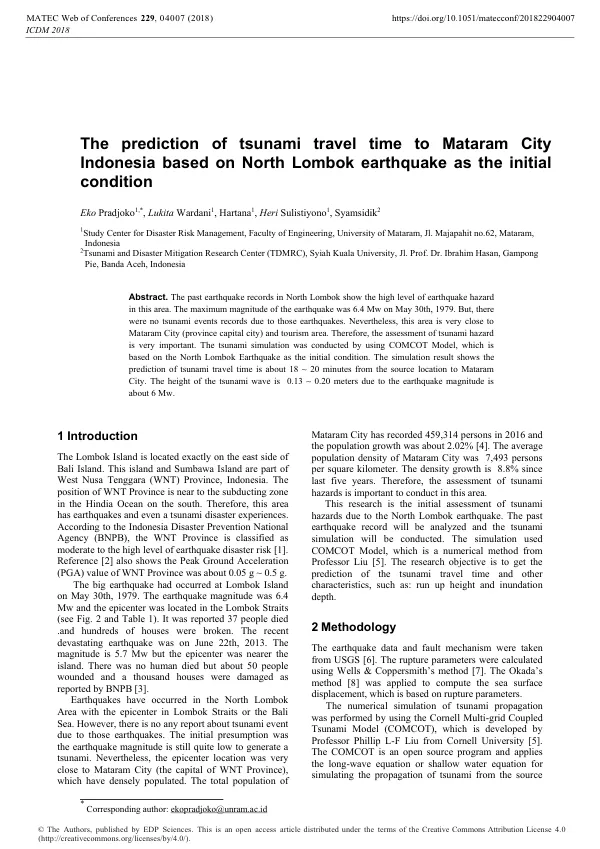
The prediction of tsunami travel time to Mataram City Indonesia based on North Lombok earthquake as the initial condition
Open record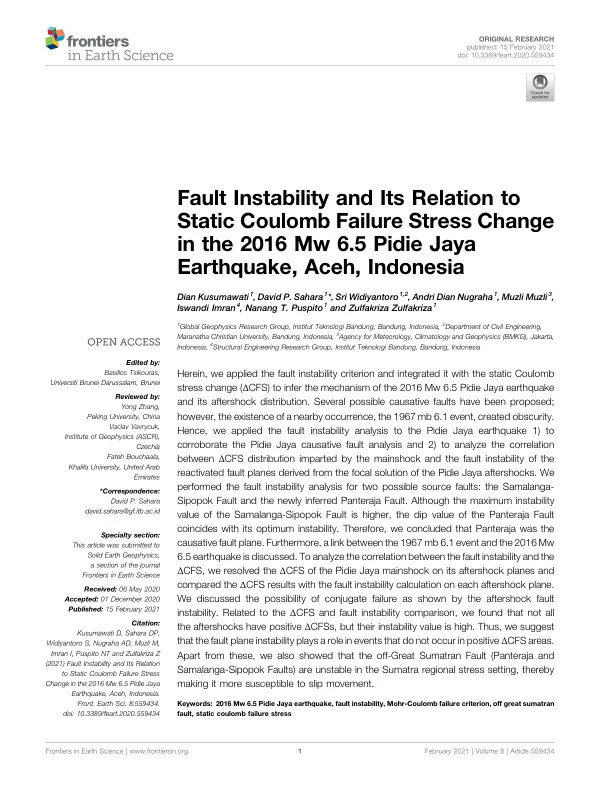 2021
2021USAID DEC
Fault Instability and Its Relation to Static Coulomb Failure Stress Change in the 2016 Mw 6.5 Pidie Jaya Earthquake, Aceh, Indonesia
Open record