MICHIGAN STATE UNIVERSITY FOUNDATION
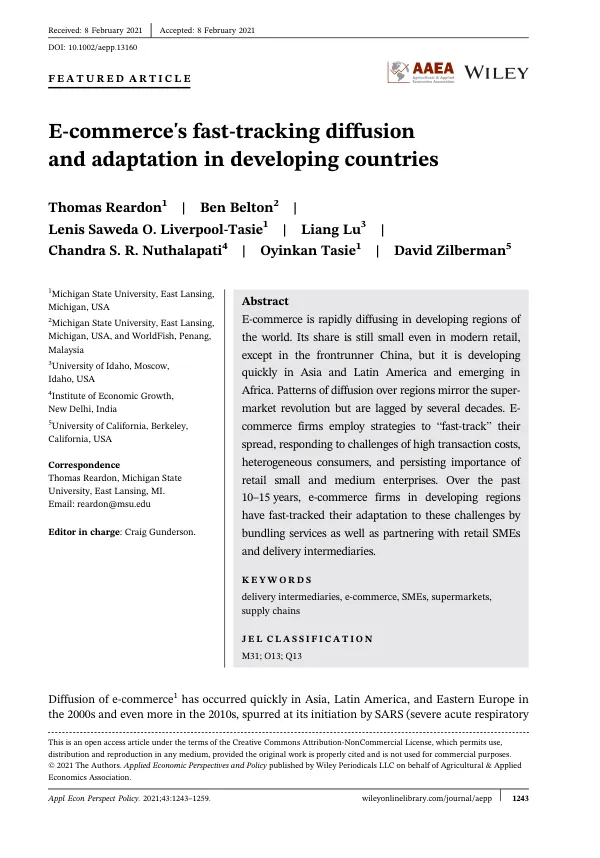
E-commerce's fast-tracking diffusion and adaptation in developing countries
E-commerce's rapid diffusion and adaptation in developing countries is a phenomenon that has been observed in various regions, including Asia, Latin America, and Eastern Europe.
2021 · 17 pages
Sign in to readA free account is required to download.
Abstract
The diffusion of e-commerce has been spurred by several factors, including the severe acute respiratory syndrome (SARS) outbreak in China in 2003 and the COVID-19 pandemic in 2020. In Africa, e-commerce is emerging but in fits and starts. The rapidity and geographic sequence of e-commerce's spread mirror the rapid spread of supermarkets and fast-food chains in the 1980s to 2000s. Outside of China, where the diffusion has already gone far, food e-commerce is still a small share of modern retail and the overall food market. It is thus like supermarkets in the 1990s, an emerging phenomenon, small but growing quickly, with demand and supply conditions appearing to point to its continued rise to eventual importance. E-commerce firms employ strategies to "fast-track" their spread, responding to challenges of high transaction costs, heterogeneous consumers, and persisting importance of retail small and medium enterprises. Over the past 10-15 years, e-commerce firms in developing regions have fast-tracked their adaptation to these challenges by bundling services as well as partnering with retail SMEs and delivery intermediaries. The diffusion and adaptation patterns in e-commerce illustrate several important economic concepts. E-commerce technology diffusion and transfer is moving from developed to developing regions, allowing the latter to "leap-frog" to advanced techniques, in parallel to other diffusion processes such as the Green Revolution agricultural technologies. Diffusion is occurring at different rates over heterogeneous regions, with early adoption in regions with better demand and supply conditions (Asia and Latin America) and with lagged adoption in Africa. The innovations of e-commerce are building or layering onto recent innovations embodied in the supermarket and computer/internet/mobile phone revolutions in developing countries. Innovators in technology as well as supply chain design adapt quickly to emerging opportunities and are spurred by crises. Intense competition among oligopolistic lead firms induces a cascade of competitive innovations in marketing tools to create demand and resolve constraints of consumers and create economies of scale and scope. In Asia, e-commerce is bounding forward, with China and India being two leaders in e-commerce. China was in the early part of the third wave of the supermarket revolution, with urbanization, income increases, and liberalization coming in the 1990s and 2000s. With that foundation, plus the rapid spread of mobile phones and the Internet, China was in the vanguard of the first wave of e-commerce diffusion. From 2003 to the present, e-commerce developed quickly, especially in the 2010s. In India, e-commerce developed into an IT hub with a cluster of IT firms oriented to the global market and, in the 2010s, to the Indian market as well. These factors together, combined with congested cities, created a context favorable to rapid e-commerce spread in India. Alibaba, a leading e-commerce company, invested in India and expanded its operations in the country. The growth of e-commerce in Asia is mirrored in the growth in sales of Alibaba, which started with B2B in 1999 and B2C in 2003. Retail sales in agricultural products on Alibaba platforms were just starting by the mid-2000s but had reached about US$7 billion in 2013 and grew fourfold to about US$28 billion in 2019. That is about twice as fast as supermarket sales grew in Asia in the 2000s. In contrast, poorer regions, such as in Africa, are well behind the above regions and e-commerce is barely emerging and in general growing slowly and in fits and starts. To show the contrast between leading and lagging regions in the diffusion of e-commerce, several countries in Asia and Africa are compared.