USAID DEC
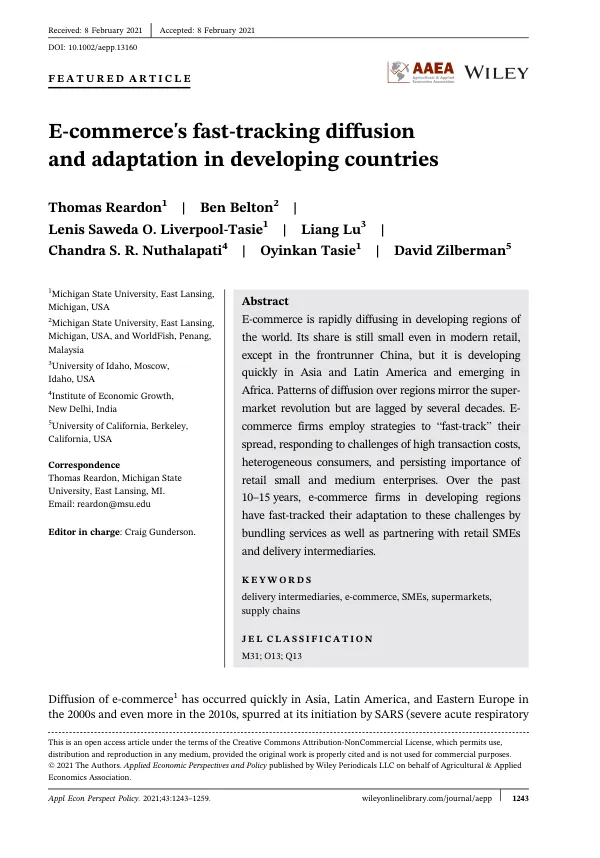
Pivoting by food industry firms to cope with COVID-19 in developing regions: E-commerce and "copivoting" delivery intermediaries
Sign inHEBREW UNIVERSITY OF JERUSALEM
Pivoting by food industry firms to cope with COVID-19 in developing regions: E-commerce and "copivoting" delivery intermediaries
Food industry firms in developing regions faced significant challenges in supplying consumers and sourcing inputs of labor and materials due to lockdown policies and consumer immobility induced by the COVID-19 pandemic.
2021 · 17 pages
Sign in to readA free account is required to download.
Abstract
Firms responded by pivoting to e-commerce to reach consumers and e-procurement to reach processors and farmers. This shift was crucial to the ability of food firms to adapt to the pandemic and maintain supply chains. The concept of pivoting refers to major, discrete adaptations by businesses in response to changing market and context conditions. In this context, pivoting involved a substantial acceleration of retail transformation into the incorporation of e-commerce, which was already emerging in developing regions before COVID-19. Food e-commerce had emerged earliest and developed fastest in China, but had been nascent in most other developing countries. The pivoting of food industry firms primarily involved shifting from or adding on to in-store or in-restaurant sales to e-commerce, and shifting from labor-using to capital-using technologies. This included a broadening of segments undertaking e-commerce, as some processors adopted it, and a broadening of scale, as some small- and medium-sized enterprises (SMEs) did. The pivoting also involved major adjustments in business strategies and operations of wholesale and logistics providers, who copivoted with food industry firms to facilitate the pivoting and take advantage of major new opportunities. Delivery intermediaries, such as Instacart, played a crucial role in facilitating the pivoting of food industry firms. These intermediaries had already developed rapidly in the United States and Western Europe, but only emerged in Asia and Latin America in the past 5 years. COVID-19 induced a substantial jump in their proliferation, both with the growth of pre-COVID-19 start-up firms and the conversion or pivoting of logistics firms into the delivery intermediary category. The concept of copivoting refers to the adjustments in business strategies and operations of wholesale and logistics providers in response to lockdown regulations related to COVID-19. This involved major shifts in the service mix of wholesale and logistics firms to become delivery intermediaries necessary to the downstream and processing firms' rapid implementation of e-commerce. The copivoting of farmers to supply new traits required by consumers and standards of supermarkets also played a crucial role in the pivoting of food industry firms. The rapid growth of large food processing firms has also led to pivoting by these firms to adjust to fundamental changes in quality and safety needs of consumers and standards of supermarkets. This required the copivoting of farmers to supply those traits, involving abrupt and substantial change in their technologies. The "supermarket revolution" in developing countries has also led to pivoting by large domestic and international supermarket chains to adjust to developing country markets. The COVID-19 pandemic has accelerated the diffusion of e-commerce and delivery intermediaries, enabling food industry firms to redesign their supply chains to be more resilient and weather the pandemic. Enabling policy and infrastructural conditions have allowed firms to pivot and copivot fluidly, facilitating the rapid implementation of e-commerce and delivery intermediaries.