CHEMONICS
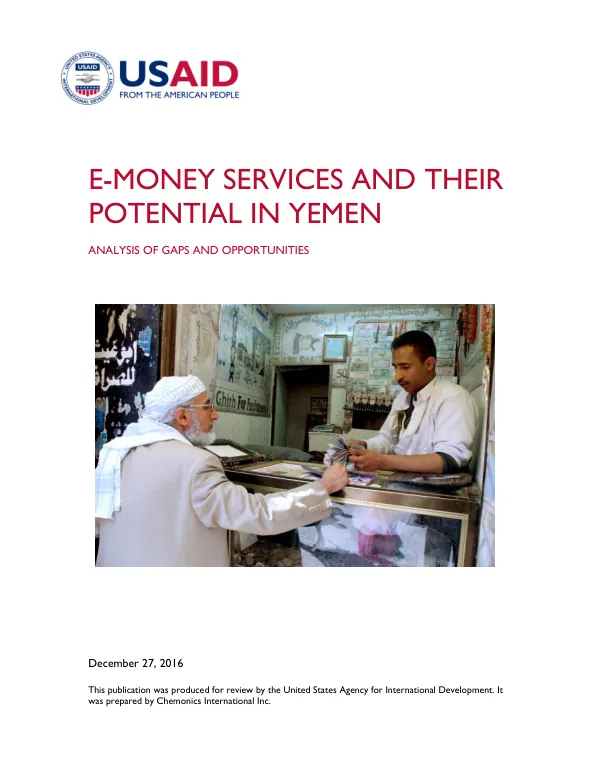
E-MONEY SERVICES AND THEIR POTENTIAL IN YEMEN: ANALYSIS OF GAPS AND OPPORTUNITIES
E-money services have the potential to facilitate the flow of salary payments and cash transfers in Yemen, addressing the humanitarian crisis in the country.
2017 · 38 pages
Sign in to readA free account is required to download.
Abstract
The objective of this report is to analyze the current e-money market and the pre-conditions needed to facilitate the expansion of e-money products and services. Yemen is just beginning to implement e-money services, and due to the ongoing conflict, many of the common preconditions seen throughout the rest of the world for successful e-money rollout are not yet in place. The Central Bank of Yemen (CBY) has granted conditional licenses to Al-Kuraimi Islamic Microfinance Bank, Al-Amal, Yemen Post, and Tadhamon International Islamic Bank to offer mobile e-money products and services. Al-Kuraimi launched its mobile e-money platform M-floos in August 2016, and Al-Amal and Tadhamon banks plan to start publicly offering their e-money services in January 2017. The CBY, along with a fairly active and engaged private sector base, has had a continuous dialogue that has resulted in a regulatory framework that supports the introduction and adoption of e-money services. However, the industry has raised several suggestions that CBY is considering, including enabling crisis-adaptable Tiered Know Your Customer (KYC) requirements for account opening, ensuring adequate access to Information and Communications Technology (ICT) infrastructure, and supporting risk-based proportionate regulatory oversight and supervision. Given the current situation in Yemen and the early stage of e-money services there, the use of e-money and e-payments will take time to develop and should not be seen as a quick fix to getting funds out to large numbers of the population in the next 6-9 months. While e-money services have been used in other countries post-crisis, these markets have tended to be a bit more advanced in terms of existing e-money and e-payment infrastructure and adoption. Support for coordination mechanisms to enable and leverage the use of digital financial services is crucial. Concerted efforts underway by the Social Fund for Development (SFD) and international donors may help to lay the initial groundwork for e-money adoption and usage in Yemen. USAID and other donors could provide support for these efforts to enable digital financial services, including integrating e-money into government/donor-led crisis cash transfers, bringing in the private sector early, and integrating initial pilot tests to ultimately digitize Government-to-Person (G2P) payments. The regulatory environment in Yemen is critical to the development of e-money services. The CBY has a regulatory framework that supports the introduction and adoption of e-money services, but the industry has raised several suggestions that CBY is considering, including enabling crisis-adaptable Tiered KYC requirements for account opening, ensuring adequate access to ICT infrastructure, and supporting risk-based proportionate regulatory oversight and supervision. In terms of e-money providers, products, and services, Al-Kuraimi Islamic Microfinance Bank, Al-Amal, Yemen Post, and Tadhamon International Islamic Bank have all applied and been granted conditional licenses by the CBY to offer mobile e-money products and services. Al-Kuraimi launched its mobile e-money platform M-floos in August 2016, and Al-Amal and Tadhamon banks plan to start publicly offering their e-money services in January 2017. The current conditions for e-money access, adoption, and usage in Yemen are challenging due to the ongoing conflict and the lack of existing e-money and e-payment infrastructure and adoption. However, there are steps that can be taken to ultimately enable e-money adoption and usage in the medium to long-term, including support to improve the policy and regulatory environment and to pilot test and initiate support for e-money services. In conclusion, e-money services have the potential to facilitate the flow of salary payments and cash transfers in Yemen, addressing the humanitarian crisis in the country. The regulatory environment in Yemen is critical to the development of e-money services, and support for coordination mechanisms to enable and leverage the use of digital financial services is crucial.