CHEMONICS
Early Grade Reading Assessment, Midline Report
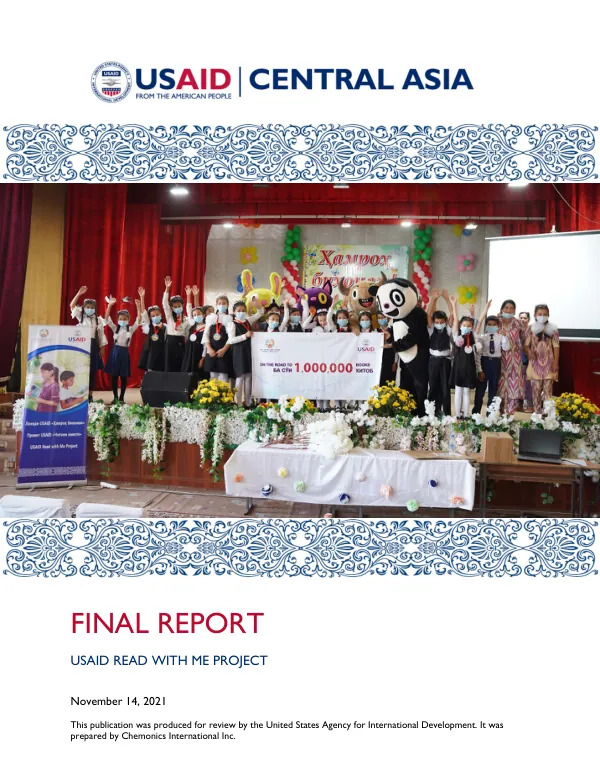
The USAID Read With Me Project is a comprehensive initiative aimed at improving early grade reading outcomes in Tajikistan.
2019 · 196 pages
Sign in to readA free account is required to download.
Abstract
The project began in 2016 with funding from the United States Agency for International Development (USAID). The primary objective of the project is to enhance reading skills among students in grades 1-3, with a focus on increasing the number of students who can read at grade level by the end of grade 3. The project's design and implementation involved a range of activities, including teacher training, school-based interventions, and community engagement. The project's technical assistance was provided by School-to-School International and Chemonics International. The assessment was planned and administered with the support of staff members in the United States and in the USAID RWM project office in Tajikistan. The Early Grade Reading Assessment (EGRA) was conducted in 2019 to evaluate the project's progress and identify areas for improvement. The assessment was implemented in all 49 districts of Tajikistan, with a total of 1,200 schools participating. The assessment tools were developed in collaboration with the Ministry of Education and Science (MoES) and the National Testing Center. The EGRA results showed significant improvements in reading outcomes among students in grades 1-3. The assessment revealed that the percentage of students who could read at grade level increased from 24% in 2017 to 34% in 2019. The results also showed that girls performed better than boys in reading, with 37% of girls reading at grade level compared to 31% of boys. The assessment results were analyzed by sex, location, region, and home language. The results showed that students from urban areas performed better than those from rural areas, with 41% of urban students reading at grade level compared to 29% of rural students. The results also showed that students from regions with higher levels of economic development performed better than those from regions with lower levels of economic development. The assessment results were contextualized through a range of additional data collection activities, including student surveys, teacher and school director questionnaires, school and classroom inventories, and lesson observations. The results of these activities provided insights into the factors that influence reading outcomes, including student-level predictors such as home language and socio-economic status, and school-level predictors such as teacher training and school resources. The discussion and recommendations section of the report highlights the key findings and implications of the EGRA results. The report recommends a range of actions to improve reading outcomes, including increasing teacher training and support, improving school resources and infrastructure, and enhancing community engagement and participation. The report also highlights the need for continued monitoring and evaluation to track progress and identify areas for improvement.
Related documents