MICHIGAN STATE UNIVERSITY
Economic aspects of non-formal education, a selected annotated bibliography
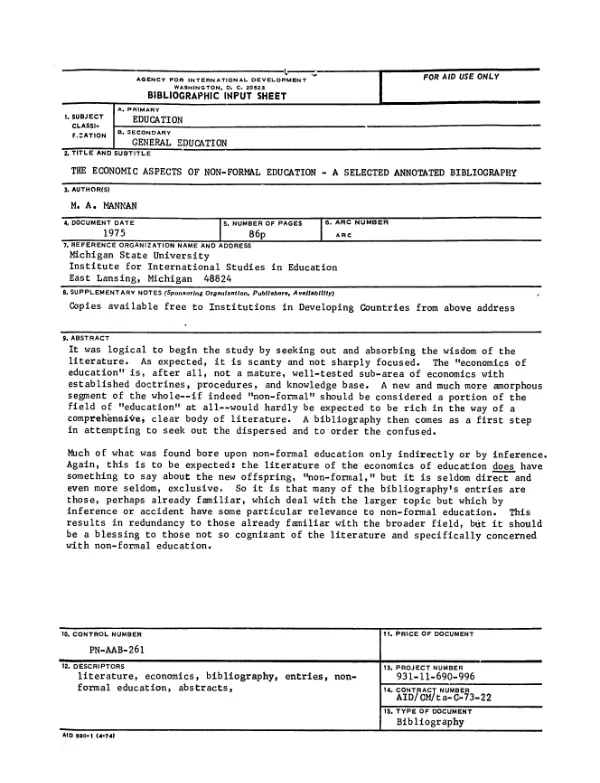
It was logical to begin the study by seeking out and absorbing the wisdom of the literature.
Mannan, M. A. · 1970
Sign in to readA free account is required to download.
Abstract
As expected, it is scanty and not sharply focused. The "economics of education" is, after all, not a mature, well-tested sub-area of economics with established doctrines, procedures, and knowledge base. A new and much more amorphous segment of the whole -- if indeed "non-formal" should be considered a portion of the field of "education" at all -- would hardly be expected to be rich in the way of a comprehensive, clear body of literature. A bibliography then comes as a first step in attempting to seek out the dispersed and to order the confused. Much of what was found bore upon non-formal education only indirectly or by inference. Again, this is to be expected: the literature of the economics of education does have something to say about the new offspring, "non-formal," but it is seldom direct and even more seldom, exclusive. So it is that many of the bibliography"s entries are those, perhaps already familiar, which deal with the larger topic but which by inference or accident have some particular relevance to non-formal education. This results in redundancy to those already familiar with the broader field, but it should be a blessing to those not so cognizant of the literature and specifically concerned with non-formal education.