AMERICAN UNIVERSITY (AU) (WASHINGTON, D.C.)
Economic development : competing paradigms (and) competing parables
Outlines alternative modes of economic development.
Weaver, J. H.; Jameson, K. P. · 1970
Sign in to readA free account is required to download.
Abstract
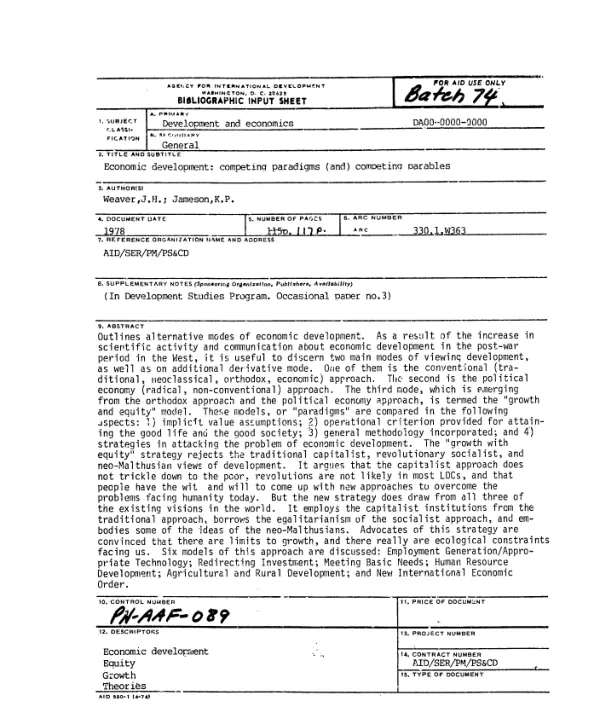
As a result of the increase in scientific activity and communication about economic development in the post-war period in the West, it is useful to discern two main modes of viewing development, as well as one additional derivative mode. One of them is the conventional (traditional, neoclassical, orthodox, economic) approach. The second is the political economy (radical, non-conventional) approach. The third mode, which is emerging from the orthodox approach and the political economy approach, is termed the "growth and equity" model. These models, or "paradigms" are compared in the following aspects: (1) implicit value assumptions; (2) operational criterion provided for attaining the good life and the good society; (3) general methodology incorporated; and (4) strategies in attacking the problem of economic development. The "growth with equity" strategy rejects the traditional capitalist, revolutionary socialist, and neo-Malthusian views of development. It argues that the capitalist approach does not trickle down to the poor, revolutions are not likely in most LDC"s, and that people have the wit and will to come up with new approaches to overcome the problems facing humanity today. But the new strategy does draw from all three of the existing visions in the world. It employs the capitalist institutions from the traditional approach, borrows the egalitarianism of the socialist approach, and embodies some of the ideas of the neo-Malthusians. Advocates of this strategy are convinced that there are limits to growth, and there are ecological constraints facing us. Six models of this approach are discussed: Employment Generation/Appropriate Technology; Redirecting Investment; Meeting Basic Needs; Human Resource Development; Agricultural and Rural Development; and New International Economic Order.