USAID DEC
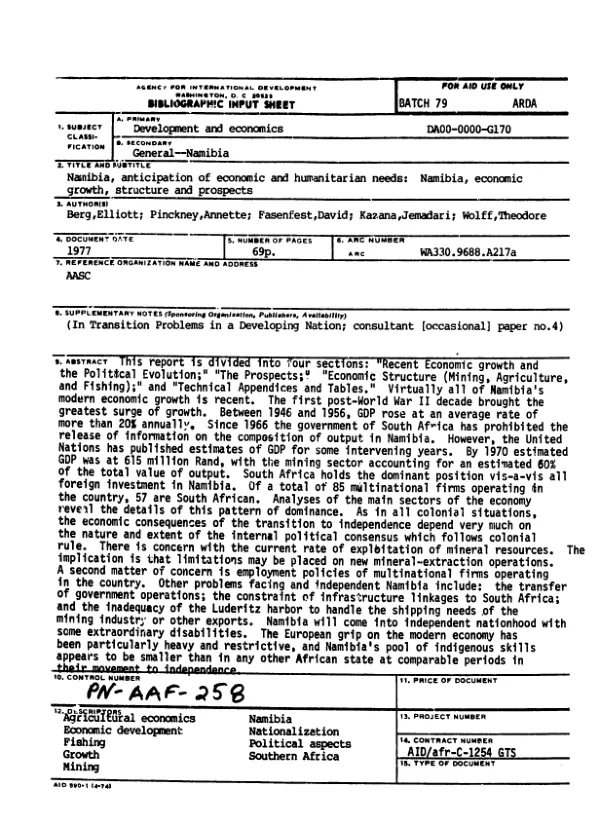
Namibia, anticipation of economic and humanitarian needs : Namibia, economic growth, structure and prospects
Sign inAFRICAN-AMERICAN SCHOLARS COUNCIL
Namibia, anticipation of economic and humanitarian needs : Namibia, economic growth, structure and prospects
This report is divided into four sections: "Recent Economic Growth and the Political Evolution"; "The Prospects"; "Economic Structure (Mining, Agriculture, and Fishing)"; and "Technical Appendices and Tables".
Berg, Elliott; Pickney, Annette · 1970
Sign in to readA free account is required to download.
Abstract
Virtually all of Namibia"s modern economic growth is recent. The first post-World War II decade brought the greatest surge of growth. Between 1946 and 1956, GDP rose at an average rate of more than 20% annually. Since 1966 the government of South Africa has prohibited the release of information on the composition of output in Namibia. However, the United Nations has published estimates of GDP for some intervening years. By 1970 estimated GDP was at 615 million Rand, with the mining sector accounting for an estimated 60% of the total value of output. South Africa holds the dominant position vis-a-vis all foreign investment in Namibia. Of a total of 85 multinational firms operating in the country, 57 are South African. Analyses of the main sectors of the economy reveal the details of this pattern of dominance. As in all colonial situations, the economic consequences of the transition to independence depend very much on the nature and extent of the internal political consensus which follows colonial rule. There is concern with the current rate of exploitation of mineral resources. The implication is that limitations may be placed on new mineral-extraction operations. A second matter of concern is employment policies of multinational firms operating in the country. Other problems facing an independent Namibia include: the transfer of government operations; the constraint of infrastructure linkages to South Africa; and the inadequacy of the Luderitz harbor to handle the shipping needs of the mining industry or other exports. Namibia will come into independent nationhood with some extraordinary disabilities. The European grip on the modern economy has been particularly heavy and restrictive, and Namibia"s pool of indigenous skills appears to be smaller than in any other African state at comparable periods in their movement to independence.