USAID DEC
Economic implications of a Middle East peace settlement : an economic development model for the West Bank and Gaza Strip
Sign inCACI, INC.
Economic implications of a Middle East peace settlement : an economic development model for the West Bank and Gaza Strip
This paper is the second of a 2-part series on the economic implications of a Middle East peace settlement.
Spector, B. I.; Kayvan, Sayeed · 1970
Sign in to readA free account is required to download.
Abstract
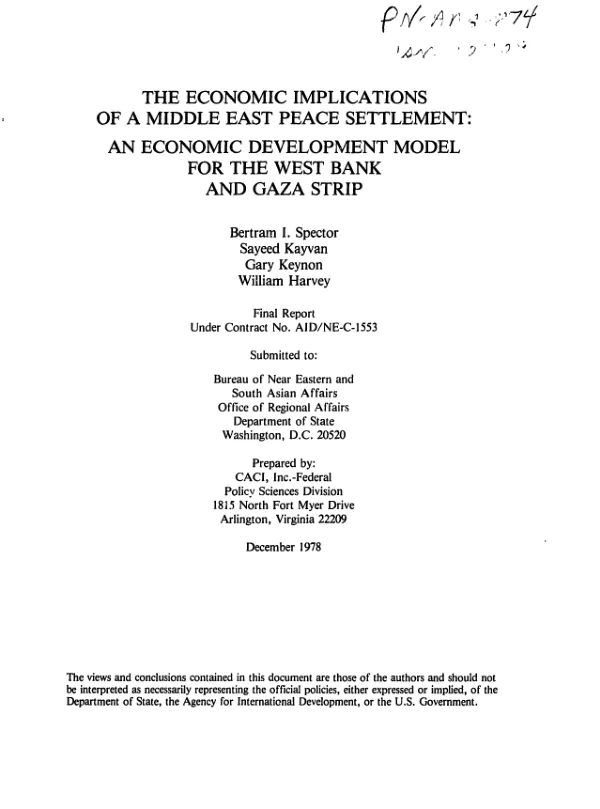
This volume presents the 5-year growth prospects for the West Bank and Gaza Strip, based on analyses of an economic development model. In order to achieve real growth in the economics of the West Bank and Gaza regions, increased domestic and foreign investments are needed over the next 5 years. If projected immigration rates of Palestinians are accurate, expanded investment and assistance are particularly needed in infrastructure development, housing, relief services, and jobs. Two alternative growth scenarios are hypothesized for the 1979-83 period, based on: (1) continued 8% annual real growth, and (2) an hypothesized 4.6-5.6% annual growth rate. The latter projection is considered more realistic. Projections of investment requirements by sector indicate that construction of housing and public facilities will require the most investment over the next 5 years. Both construction and public services can be easily expanded to meet needs if investment capital is made available. Immediate expansion in agriculture will be more difficult, due to scarce land and water resources. Government development plans should be encouraged to improve the absorptive capacity of the industrial sector. Initially, high investments of foreign capital in the West Bank and Gaza will be required for development of infrastructure and to provide relief services for incoming Palestinians. Gaza will likely require assistance and investment due to its less developed economy. Rapid economic growth in these areas can be stimulated by: (1) establishing a stable and secure political environment for investment; (2) implementing an economic development plan to structure and guide growth; (3) providing government incentives to channel domestic savings into investment and encourage private foreign investment; and (4) developing adequate public infrastructure to facilitate the successful absorption of private capital investment. An extensive bibliography of references used by the authors of this report is included.