USAID. MISSION TO PANAMA
Economic policy development
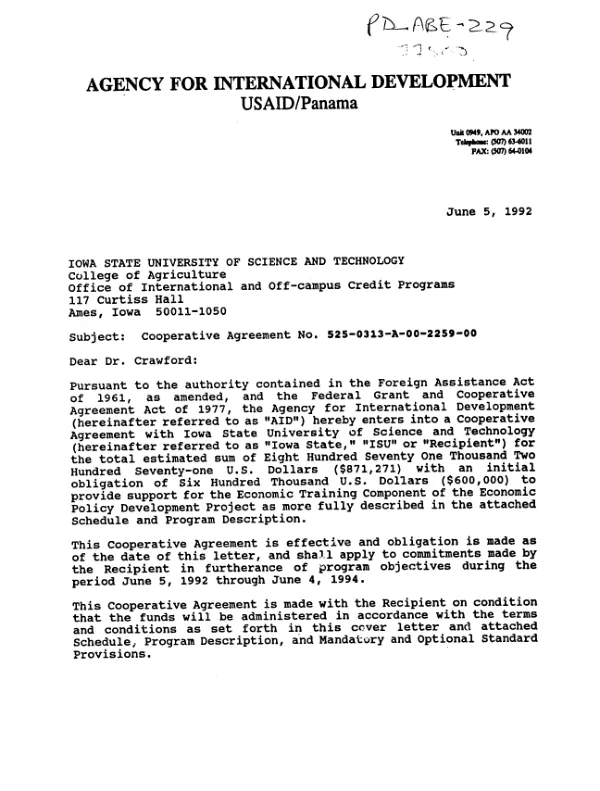
Project to expand and strengthen the Government of Panama"s (GOP) economic policymaking capability.
1991
Sign in to readA free account is required to download.
Abstract
The project will have three components: economic policy, economic training, and planning for Panama"s assumption of responsibility for the Panama Canal at the end of 1999. The project will provide TA to support the economic policy reform efforts of a new special unit -- Unidad Coordinadoro (UC) -- being created within the Ministry of Planning and Economic Policy (MIPPE). Specifically, the project will finance: 18 months of short-term TA on social security reforms, including an actuarial study of the pension system, analysis and reform of health care financing, and financial and management reports; 24 months of TA in budget preparation and public investments; 30 months of short-term TA to help MIPPE to prepare divestment plans for some 15 state-owned enterprises; 3 months of short-term TA to develop an action plan to revise restrictive labor practices and find ways to soften the impact of labor reform (e.g., through unemployment insurance); 2 months of short-term TA to analyze the impact of trade reform and find ways of softening the adjustment process; and a long-term economist to give on-the-spot macroeconomic advice to Panamanian leaders and coordinate TA in the above-mentioned areas. The project will also fund 6 personal computers along with software to establish a network at MIPPE"s Statistics and Census Department. TA efforts will be complemented by an in-house economics training program for 100 MIPPE employees (50 per year), focusing on priority areas for economic reform. Courses will be conducted either in a traditional semester format or under a more intensive schedule, e.g., summer school, and will cover macroeconomics, microeconomics, economic statistics, and special topics such as tax reform, budget policy, health care economics, etc. The training will be conducted by a competitively selected educational institution. Finally, the project will assist the GOP and the private sector in identifying alternatives for management of the Canal, and will contribute to preparation of an integrated development plan for the reverted area under terms of reference being prepared by the UNDP. Since political sensitivities preclude USAID/P from taking a direct role in recommending to the GOP how the Canal should be managed after 1999, USAID/P will not approve or reject whatever management structure is chosen, but will focus its efforts in assuring that the public is aware of the importance of the Canal to Panama and that all management alternatives are analyzed. Pro-Ag amendment of 8/26/94 extends PACD 2 years to 9/30/96, and further assists the GOP in assuming responsibility for the Panama Canal by financing commodities and/or TA for: (1) the Interoceanic Regional Authority (ARI) in specialized fields such as legal, data base, and real estate management; (2) the Presidential Commission for Canal Affairs in preparing an organic law establishing the Panama Canal Authority (ACP), and updating the strategic plan for takeover of the Canal; and (3) the ACP or transitional entities. The amendment also increases short-term TA to MIPPE for policy reform and the number of trained public sector economists to 125-130. (PD-ABJ-651) Pro-Ag amendment of 7/14/95 increases funding and extends the PACD 3 years to 9/99 to coincide with the scheduled transfer of the Canal (to be overseen by the recently established Panama Canal Transition Commission) and reversion of the remaining bases. TA will be provided to ARI and ACP to facilitate the transfer process and ensure that reverted properties are used for productive purposes; additional geographic information systems (GIS) equipment will be provided to ARI. No funds are provided for maintaining and securing the reverted properties or for toxic waste clean-up. (PD-ABM-153)
Related documents