USAID. BUR. FOR LATIN AMERICA AND THE CARIBBEAN. REGIONAL OFC. FOR CENTRAL AMERICAN PROGRAMS (ROCAP)
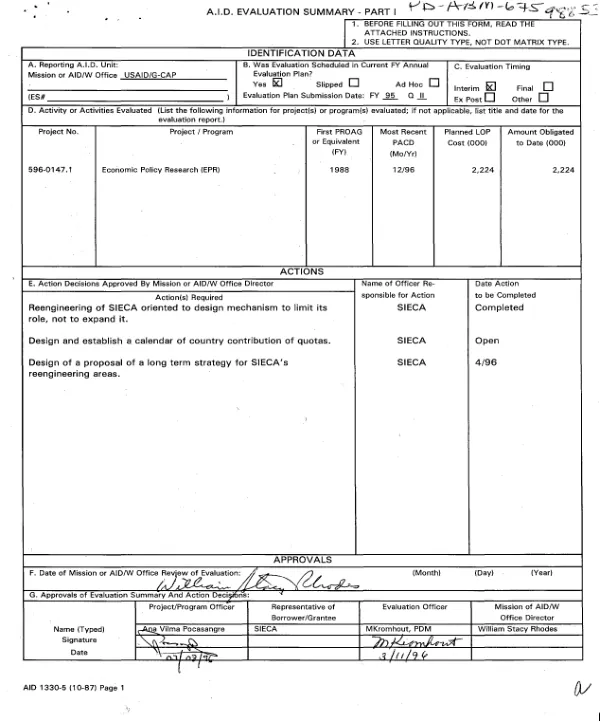
Economic policy research (EPR)
Summarizes attached interim evaluation of a project to increase the quantity and quality of work done by economic research centers and universities in Central America.
1996
Sign in to readA free account is required to download.
Abstract
The evaluation covered the period 1988-1/95. This poorly designed project must be considered a failure: almost none of its objectives have been met. The mere fact that economic policy analysis was weak in Central America did not imply that this project was needed, since considerable assistance was already being provided to individual countries by USAID and other donors. The choice of the Permanent Secretariat of the General Treaty of Central American Economic Integration (SIECA) as lead agency was also a poor one; SIECA is not respected in the region as an institution that produces useful economic research. SIECA has implemented the accounting program recommended by Price Waterhouse, with good results, but SIECA is not implementing Price Waterhouse"s proposed organizational reforms -- which admittedly are in themselves flawed. Since July 1994, a new leadership, workplan, and several meetings with USAID/G-CAP on administrative issues have left SIECA better prepared to assume functions of regional harmonization. On the whole, however, SIECA"s present technical capability and orientation will not guarantee satisfactory results. Despite its problems, SIECA remains the only broadly based institution that is truly regional; it is the responsible body for administering Central American economic integration, its status as such having been confirmed by the Central American presidents and by the Protocol of Guatemala. But the demands made on SIECA are enormous and unreasonable -- almost every meeting of the regional economic cabinets or other organizations in the Central American economic integration subsystem results in a flood of demands for SIECA to study something. This problem is exacerbated by the attitude of some SIECA staff that anything having implications for regional integration should be studied and/or controlled by SIECA. SIECA must find ways to limit its role, not expand it. Unless it does, and unless the timely payment of country financial contributions is forthcoming, it is doomed to irrelevance. The Mission notes that if it does continue to work with SIECA, it will take care to make any future commitment productive, and that changes in SIECA"s leadership in 5/95 have strengthened its position and helped to reorganize internally and accomplish its project commitments.
Related documents
![Project assistance completion report : economic policy research project - INCAE [Central American Institute of Business Administration] component](https://covers.devme.ai/gen/7659.webp)
![Project assistance completion report : economic policy research project - INCAE [Central American Institute of Business Administration] component](https://covers.devme.ai/gen/38222.webp)