USAID DEC
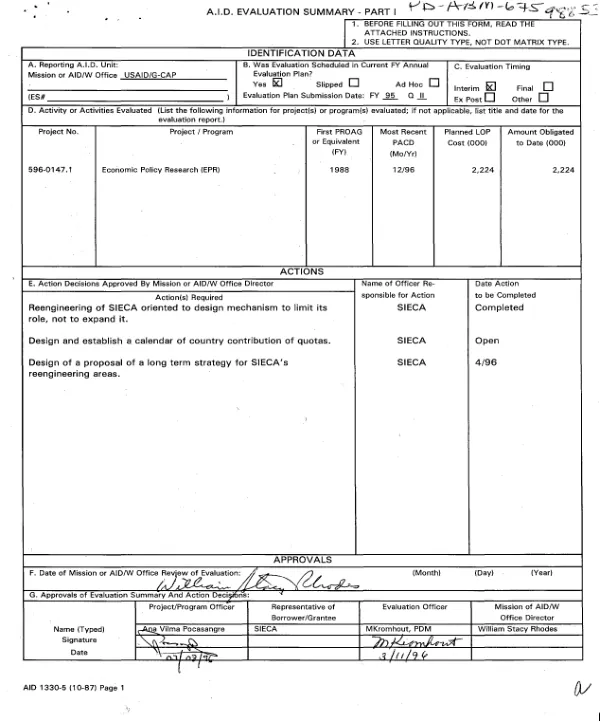
Project assistance completion report : economic policy research project - INCAE [Central American Institute of Business Administration] component
Sign inUSAID. BUR. FOR LATIN AMERICA AND THE CARIBBEAN. REGIONAL OFC. FOR CENTRAL AMERICAN PROGRAMS (ROCAP)
Project assistance completion report : economic policy research project - INCAE [Central American Institute of Business Administration] component
PACR of a project 8/88-6/93 to upgrade the policy analysis capabilities of economic research centers and universities in Central America.
1994
Sign in to readA free account is required to download.
![Project assistance completion report : economic policy research project - INCAE [Central American Institute of Business Administration] component](https://covers.devme.ai/gen/7659.webp)
Abstract
The report focuses on the Central American Institute of Business Administration (INCAE), one of the project's three implementing agencies. Over the life of the project, INCAE researchers prepared 15 studies on such subjects as the informal economy, the social costs of economic adjustment, economic and industrial modernization, and economic stabilization. In addition, INCAE conducted seminars for cabinet-level economic policymakers and for members of Central American Chambers of Commerce; subjects included structural adjustment, financial reform, debt management, economic management, and industrial reconversion. INCAE also conducted 9 courses for 109 junior researchers in such areas as macroeconomic analysis, structural adjustment, and sectoral policy; the junior researchers went on to prepare 35 studies applying the techniques and methodologies they had learned. INCAE's major impact was in the areas of training and policy dialogue. Several of the training participants went on to become high-level personnel in key development offices in their countries. In the area of policy dialogue, INCAE played a key role in facilitating discussions by public and private national leaders on difficult economic topics. The following lessons were learned. (1) Steering Committees that provide guidance in research projects should be aware of "real world" issues, not simply technical problems. A failure in this regard early in this project led to studies that, while relevant and interesting, were not timely. (2) When two or more entities participate in a project, both should be involved in project planning from the beginning. (3) An aggressive dissemination program, including nontechnical publications for the general public, should be implemented after research has been reviewed at the technical level. Politicians, government officers, private sector leaders, and the general public are eager for good analyses.
![Project assistance completion report : economic policy research project - INCAE [Central American Institute of Business Administration] component](https://covers.devme.ai/gen/38222.webp)