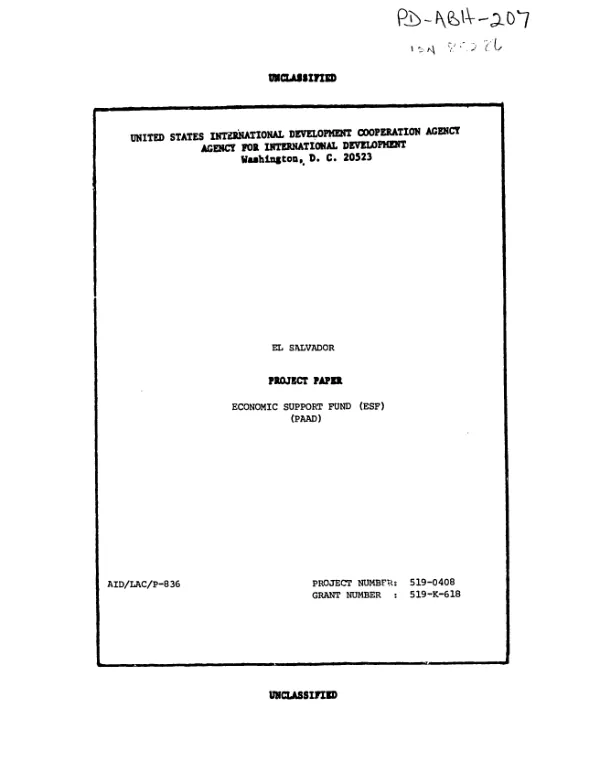
USAID. MISSION TO EL SALVADOR
Economic support fund (ESF)
FY 1993 ESF program to support economic and democratic reform in El Salvador.
1993
Sign in to readA free account is required to download.
Abstract
A cash grant of $55 million will be conditioned on policy reforms to accelerate broad-based economic growth, strengthen democratic institutions and processes, and improve public sector accountability. Dollars will be used to import U.S. goods and petroleum for the productive private sector. The Government of El Salvador (GOES) will provide an equal amount of local currency for mutually agreed on development purposes. Conditions to consolidate sustainable economic growth are to: (1) increase the efficiency of the electricity sector (e.g., developing a regulatory framework for the sector, drafting laws for the National Electricity Council); (2) modernize tax and customs administration; (3) reduce the role of the state through privatization, a freeze on public employment, and decentralizing authority to municipalities; (4) improve financial intermediation (by encouraging competition among and supervision of banks); (6) promote exports; (7) maintain an adequate macroeconomic framework and structural/sector adjustment policies; (8) increase cost-recovery at public health facilities; (9) increase budget allocations to education; and (10) develop a national strategy for environmental protection and natural resource management. Conditions aimed at strengthening democracy are to: (1) implement the GOES justice sector reform program; (2) support efforts of the Supreme Electoral Tribunal and the Salvadoran Institute for Municipal Development (ISDEM) to prepare for the 1994 elections; and (3) promote respect for workers rights (e.g., by a making a good faith effort to meet the targets agreed in the "Social Pact" forum and submitting a revised labor code to the Legislative Assembly). Conditions to increase public accountability are to: (1) make the management of public resources more efficient by transferring the pre-control function from the Court of Accounts to the executing agencies, making modern ex-post audits by the Court of Accounts the vehicle for government oversight, and unifying the GOES ordinary and "extraordinary" (donor funds) budgets; and (2) improve public sector cash management by reducing the time required by the central government to pay suppliers.
Related documents