ACADEMY FOR EDUCATIONAL DEVELOPMENT, INC. (AED)
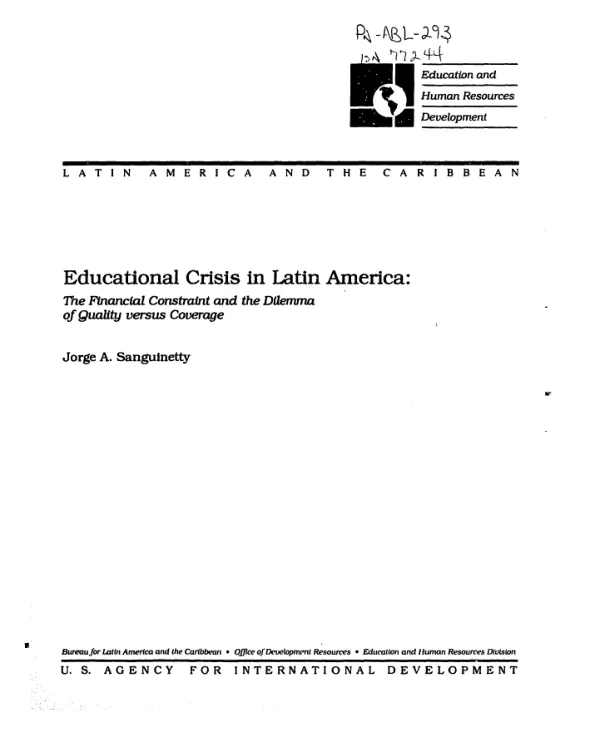
Economics of basic education in El Salvador
Total expenditures for education in El Salvador almost doubled between 1970 and 1980 in real terms (adjusted for inflation), while expenditures for basic education increased 2.32 times.
Sanguinetty, Jorge A. · 1989
Sign in to readA free account is required to download.
Abstract
However, expenditures for education then fell 48% in real terms between 1980 and 1987, returning to virtually the same level reached in 1970. Basic education lost a significant amount of real resources, as total expenditures for all levels of education for 1987 were less than those for basic education alone in 1980. Salaries constitute 93-97% of the education expenditures. This implies that policymakers lack a financial instrument to implement improvements in education, since the budget is driven by the payroll. The exaggerated proportion of salaries severely distorts the structure of expenditures, which cuts into the efficient use of education resources. Nonetheless, the mean real teacher salary in basic education has fallen 60-67% in the 1980-89 period. The major short-term effect of this decline is that many teachers hold one or two additional jobs (pluriempleo) which aggravates the situation created by teachers" poor attendance record at many schools. This seriously damages teacher performance in the classroom, especially in the presence of a total lack of supervision. The long-term effect can be even more grave since, with a secular decline in real salaries, only individuals from the most marginal socioeconomic levels of El Salvador would be attracted to the teaching profession. Parallel to the predominance of salaries in basic public education (the Ministry of Education"s (MOE) main activity is personnel administration) are issues such as the output quality of education, virtually neglected in the range of educational policy choices. The employment-salary equation is what determines the nature of the relationship between the MOE and the teachers" union. The possibilities for educational development in El Salvador are constrained by the concentration of administrative power in the MOE, and the concomitant concentration of power in the teachers" union. In this context, communities (and parents) have no influence in the educational process. The current educational management structure is creating a system of permanent dependence on foreign assistance. As the economic and fiscal prospects of El Salvador do not allow optimistic expectations about increases in the educational budget, the dependence on foreign assistance is expected to continue. It is necessary to reduce the financial dependence of educational development by implementing adapted technologies. A major strategic reform of MOE and union roles must be carried out. There are competent and dedicated personnel among the ranks of the MOE who must be given significant participation in the restructuring of basic education. They must be the main protagonists of educational reform -- not foreign consultants and contractors. It also is necessary to promote a strategic alliance between MOE and the teachers" union to transform the prevailing antagonistic relationship into one of mutual support and understanding. A central objective of such an alliance is to influence the central government and the general public to invest in education and improve the economic and social status of the teacher, with strong community involvement. (Author abstract, modified)