CREATIVE ASSOCIATES INTERNATIONAL, INC. (CAII)
EDUCA evaluation
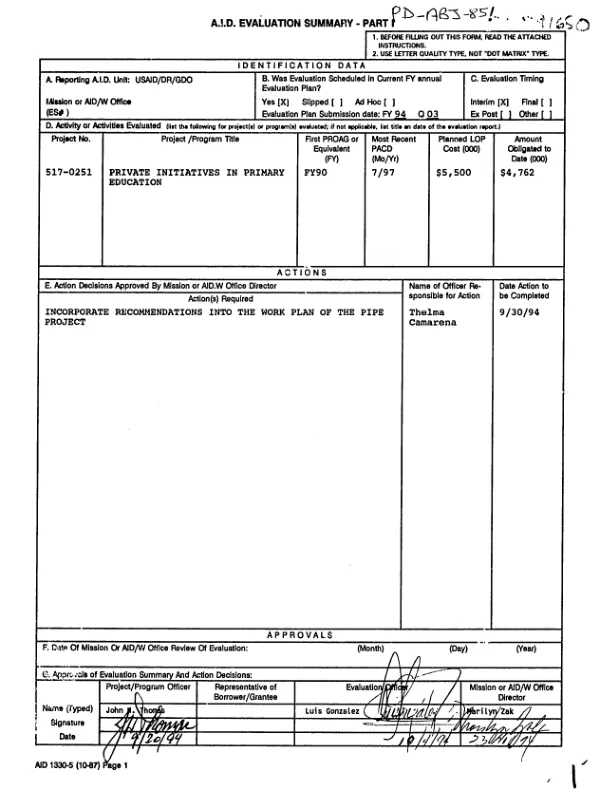
Final evaluation of a project (1990-12/97) to improve the capacity of the Action Committee for Basic Education (EDUCA), a nascent NGO, in improving primary education in the Dominican Republic (PIPE project).
Bernbaum, Marcia|Locher, Uli · 1997
Sign in to readA free account is required to download.
Abstract
EDUCA, organized in 1990 by a group of businesspeople, is highly regarded as a non-partisan organization in a highly polarized country. The organization provides services to the education community, particularly in low-income areas, and its decision to focus on the public as well as the private sector has contributed significantly to its credibility. EDUCA's Board of Directors is composed of a highly dedicated group of Dominicans, which continues to incorporate fresh talent, including young, up-and-coming businesspeople. A group of highly respected educators and academics serve the Board in an advisory capacity. EDUCA has forged links between education institutions that might not have otherwise associated with one another, such as seven institutions that now work together to design teacher training programs. A strategy of contracting with other institutions instead of developing its own capacity for service delivery has enabled EDUCA to avoid the pitfalls of having a large administrative structure, strengthen other institutional capabilities, and develop valuable allies that it can tap for other efforts. EDUCA has forged links between public and privates schools, possibly a first in the Dominican Republic. It has also collaborated with the World Bank and the Interamerican Development Bank (IDB) in the implementation of their first educational loans, provided the IDB with TA for textbook development, and collaborated with IDB's expansion of the teacher training program. In 1989/90, EDUCA mediated between the government and the teachers' union to bring a major teachers' strike to an end by persuading the government to raise teachers' salaries. Support from the PIPE project enabled EDUCA to show that textbooks of high quality can be produced in a short period of time, and to provide a training program that has received universal acclaim. Training provided under PIPE focused on implementing the 10-Year Plan and the pending Educational Reform Law and focused on both school directors and teachers. School directors trained by EDUCA are implementing new management procedures, have become promoters of the Educational Reform Law, and have even established a 500-member alumni association, which is likely to become a significant voice in ensuring implementation of the Reform Law. Teachers trained by EDUCA have shown significant increases in knowledge and comprehension of the training and now use a more participatory instructional approach. In short, EDUCA has succeeded in putting education on the Dominican national agenda. Yet, EDUCA faces a number of challenges. Members of EDUCA's board have diverging views on what its mission should be, EDUCA is not operating strategically, and its funding from USAID will be terminated at the end of 1997. However, unlike most non-profit organizations in the country, EDUCA's Board of Directors has cultivated the ability to obtain resources, both through monetary and in-kind contributions. Also, while EDUCA is expected by many to play a key role in pulling together individuals from various walks of society, EDUCA staff are divided on whether and how to carry out this renewed advocacy role. While EDUCA has reached out to low-income areas, it is still seen as a somewhat elitist organization. Finally, some PIPE activities (e.g., achievement testing, management information systems) were less successful and need to be rethought. The evaluation includes general lessons learned for donors and for grantee/implementing organizations.
![Project assistance completion report (PACR) : FUNDAZUCAR [Fundacion del Azucar] girls' education component of the Basic Education Strengthening (BEST) project (no. 520-0374)](https://covers.devme.ai/gen/5889.webp)