USAID. MISSION TO DOMINICAN REPUBLIC
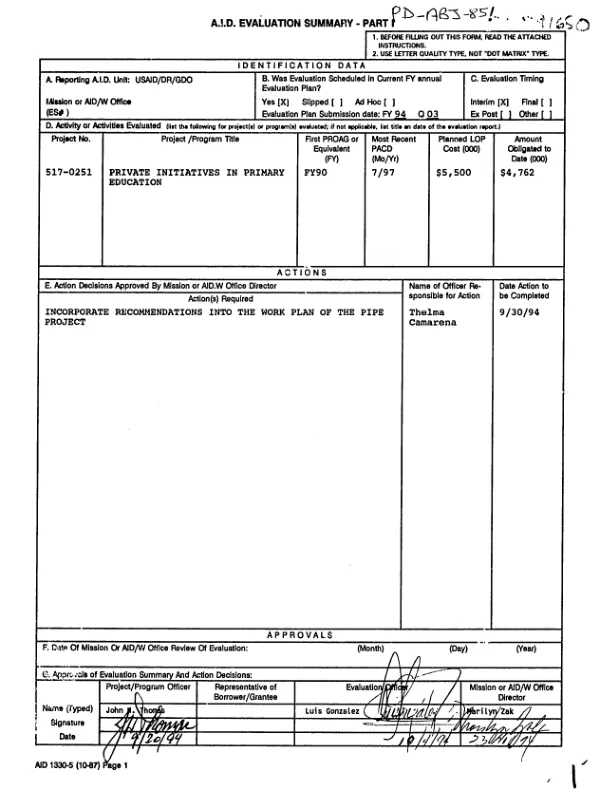
Private initiatives in primary education
Summarizes interim evaluation (PD-ABJ-061) of a project to establish an administrative and technical capacity within Action for Basic Education (EDUCA) to promote primary education in the Dominican Republic.
1994
Sign in to readA free account is required to download.
Abstract
The evaluation covered the period 1990-7/94. The project is on track. TA more than met project requirements, and as a result EDUCA has developed considerable administrative capacity, and is well on its way to complete independence. EDUCA program staff are adequate in number, but EDUCA needs pre- and inservice training for staff and to utilize its staff assessment system. The first school selection process was well done, but the process is not actively targeting the poorest schools. EDUCA can manage the project itself, with more attention to the planning, focus, staffing, and implementation problems identified during the evaluation. Four of the EOPS and output indicators under the project are no longer valid and should be adjusted. Most technical activities have also been successful. Training programs have been completed as planned, but are reaching fewer beneficiaries than targeted. The achievement testing program is on schedule and of high quality, instructional materials development is on track, and the school census was completed and used to select schools for the training program. On the other hand, the professional development schools, the management information system, and the clearinghouse are not yet in place. The following lessons were learned. (1) When a project involves individuals of high national, political, and economic stature, it is possible to involve the private sector with relatively small inputs and to positively influence and leverage national educational policy. (2) Development of a new institution, even a small one, takes longer than the 2 years allotted in this project. (3) A steady series of timely, well-executed professional technical inputs can be used to quietly influence and change the course of an educational system not meeting a country"s basic education needs. (5) The project got off to a good start because the directors were trained first, enabling and the program to put a trained cadre in place to network and coordinate activities. (6) The project developed some problems during implementation, which have become magnified. More continual process monitoring will usually help project and Mission managers to resolve difficulties early on. (7) This project is replicable in other Latin American countries.