USAID
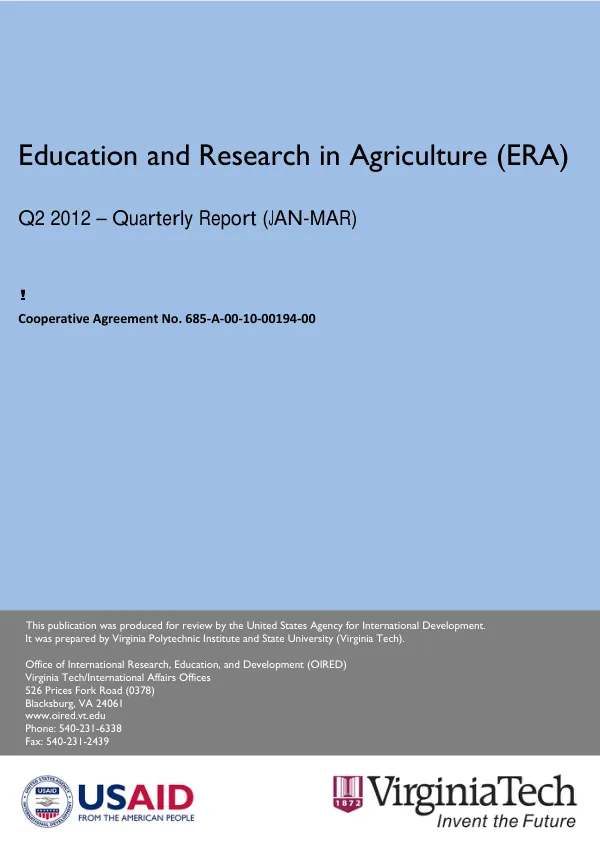
Education and Research in Agriculture (ERA) Q2 2012 – Quarterly Report (JAN-MAR)
The agricultural education and training system in Senegal is being strengthened through the USAID/ERA project.
2012 · 40 pages
Sign in to readA free account is required to download.
Abstract
This initiative aims to support poverty and hunger reductions, and inclusive economic growth in Senegal as part of the Feed the Future program. The project focuses on three main components: Agricultural Education, Strengthening Applied Research and Outreach, and Project Management and Policy Support. In the Agricultural Education component, USAID/ERA implemented several high-yield activities and engagements, including focused training, workshops, equipment deliveries, collaborative research efforts, pilot eLearning implementation, and scholarships initiatives. These interventions have allowed the project to obtain significant results that strengthen human and institutional capacities and reach local AETR partner institutions in all major regions and places of operation in Senegal. One of the key achievements in this component was the successful workshop for women producers in the Casamance region, which provided more than 150 women entrepreneurs and young scholars with the tools and necessities to advance in their post-school careers and professional lives. Additionally, a practical and comprehensive workshop on career opportunities in the agricultural sector was conducted, targeting young collegiate professionals from a cross-section of the AETR partners of the project. In the Strengthening Applied Research and Outreach component, USAID/ERA implemented several activities, including the ERA Signature research program, outreach and support activities, and coordination of project activities to create synergies between USAID/ERA and other NGOs. The project also conducted a joint collaboration with Wula Nafaa in the valley of Ndinderling, which aimed to promote innovative research solutions to public/private clients. In the Project Management and Policy Support component, USAID/ERA implemented several activities, including the management and administrative systems of target AETR strengthened, study tour of the US and East Africa on Public-Private Collaborations, and administrative support grants. The project also conducted a send-off ceremony organized at the residence of the Director of USAID, in honor of participants traveling in the US and Africa on the Study Tour. The project has made significant progress in strengthening human and institutional capacities, reaching local AETR partner institutions in all major regions and places of operation in Senegal. The project has also placed a great focus on gender and outreach, with two major achievements being the successful workshop for women producers in the Casamance region and the practical and comprehensive workshop on career opportunities in the agricultural sector. The USAID/ERA project has implemented several key priority education-oriented interventions, including syllabus development at the University of Thiès, ERA eLearning Pilot Deployment, and scholarships initiatives. These interventions have allowed the project to obtain significant results that strengthen human and institutional capacities and reach local AETR partner institutions in all major regions and places of operation in Senegal. The project has also made significant progress in implementing the ERA Signature research program, outreach and support activities, and coordination of project activities to create synergies between USAID/ERA and other NGOs. The project has also conducted a joint collaboration with Wula Nafaa in the valley of Ndinderling, which aimed to promote innovative research solutions to public/private clients. Overall, the USAID/ERA project has made significant progress in strengthening the agricultural education and training system in Senegal, supporting poverty and hunger reductions, and inclusive economic growth in Senegal as part of the Feed the Future program. The project has implemented several high-yield activities and engagements, including focused training, workshops, equipment deliveries, collaborative research efforts, pilot eLearning implementation, and scholarships initiatives. The project has also placed a great focus on gender and outreach, with two major achievements being the successful workshop for women producers in the Casamance region and the practical and comprehensive workshop on career opportunities in the agricultural sector. The project has also made significant progress in implementing the ERA Signature research program, outreach and support activities, and coordination of project activities to create synergies between USAID/ERA and other NGOs. The project has also conducted a joint collaboration with Wula Nafaa in the valley of Ndinderling, which aimed to promote innovative research solutions to public/private clients. The project has also implemented several activities in the Project Management and Policy Support component, including the management and administrative systems of target AETR strengthened, study tour of the US and East Africa on Public-Private Collaborations, and administrative support grants.