USAID DEC
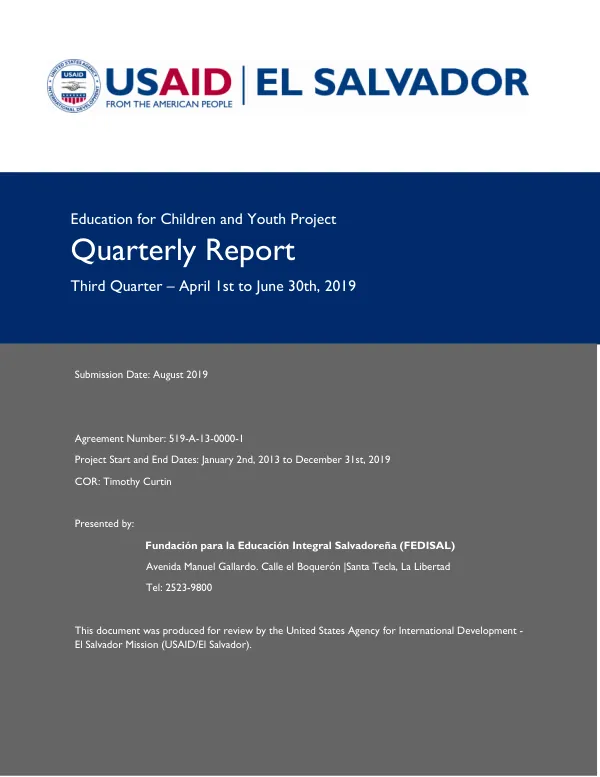
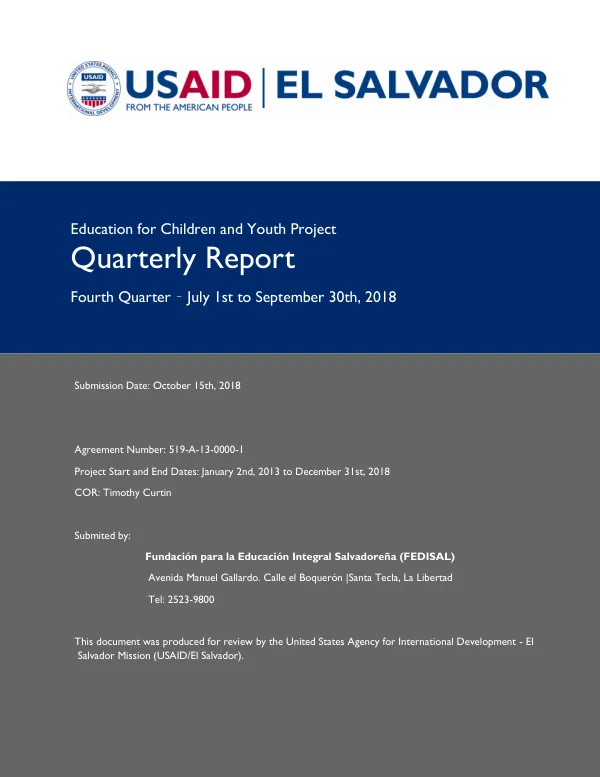
Education for Children and Youth Project Quarterly Report Fourth Quarter – July 1st to September 30th, 2018
Sign inMINISTRY OF EDUCATION
Education for Children and Youth Project Quarterly Report Fourth Quarter – July 1st to September 30th, 2018
The Education for Children and Youth Project (ECYP) is a bilateral agreement between the Government of El Salvador and the Government of the United States of America.
2018 · 33 pages
Sign in to readA free account is required to download.
Abstract
The project aims to support the expansion and implementation of the Full Time Inclusive School (FTIS) approach, which seeks to expand access to education among children and youth living in municipalities with high violence and crime rates in El Salvador. The project is implemented by Fundación para la Educación Integral Salvadoreña (FEDISAL) and is supported by the United States Agency for International Development (USAID). The project has satisfactorily fulfilled its planned activity development and defined goals. The report presents the achievements and activities that ECYP performed during the fourth quarter of the USA fiscal year (FY2018, Q4) within the period from July 1st to September 30th, 2018. The report highlights the project's efforts to promote safe learning environments, provide incentives to low-income students, support out-of-school youth, and promote public-private partnerships. During the fourth quarter of 2018, the project carried out a series of activities related to its strategic areas. The project supported 270 upper-primary and lower-secondary principals and vice-principals, as well as 109 MINED staff members, in reinforcing pedagogical processes and improving academic results of fourth to ninth graders. The project also provided technical assistance concerning active methodologies in teaching Spanish, mathematics, and inclusive education. The FTIS approach has been implemented in 651 schools, equivalent to 96.1 percent of all the schools intervened by ECYP. Among the 651 intervened schools, 95.9 percent have promoted inclusive education and classroom redesign. Similarly, 93.9 percent of intervened schools have formed Peer Learning Circles for teachers specialized in Spanish, mathematics, and science. The learning circles aim to improve teaching practice and multiply participants' experience through the ripple effect. The project also reinforced safe learning environments by providing technical assistance and strengthening to school directors, teachers, and students. The project anticipates that the audience receiving the technical assistance will adopt the tools provided by the project in their schools. Additionally, the project offered induction on the use of the Portal Edujovenes and motivated a greater number of educational actors to interact using this educational tool. The project's efforts to promote safe learning environments, provide incentives to low-income students, support out-of-school youth, and promote public-private partnerships have been successful. The project has made significant progress in implementing the FTIS approach, promoting inclusive education, and improving teaching practices. The project's achievements and activities during the fourth quarter of 2018 demonstrate its commitment to supporting the expansion and implementation of the FTIS approach in El Salvador. The project's impact on the homicide rate in El Salvador is also noteworthy. According to the official figures of homicides published in June 2018, the 2018 rate would decrease to 54 homicides per 100,000 inhabitants. This decline in the homicide rate is expected to continue through the end of 2018, maintaining the declining trend observed since 2016. The project's achievements and activities during the fourth quarter of 2018 demonstrate its commitment to supporting the expansion and implementation of the FTIS approach in El Salvador. The project's efforts to promote safe learning environments, provide incentives to low-income students, support out-of-school youth, and promote public-private partnerships have been successful, and the project's impact on the homicide rate in El Salvador is also noteworthy.