USAID DEC
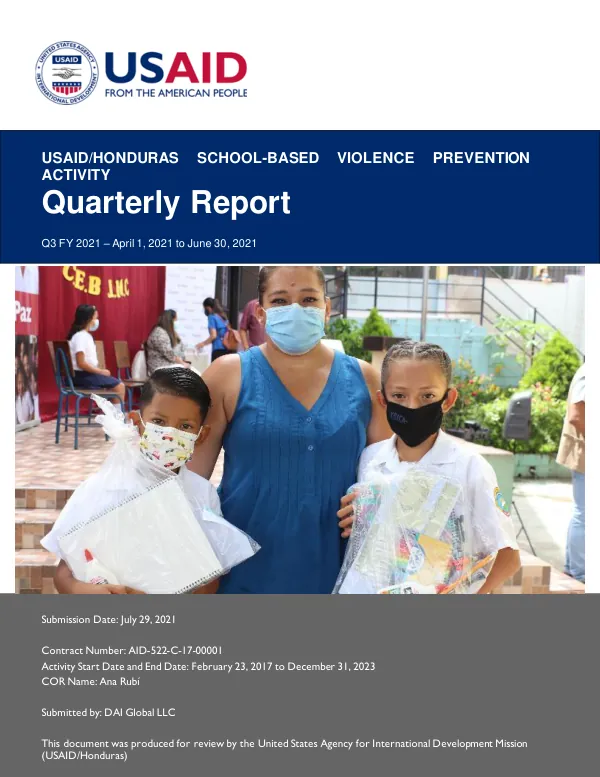
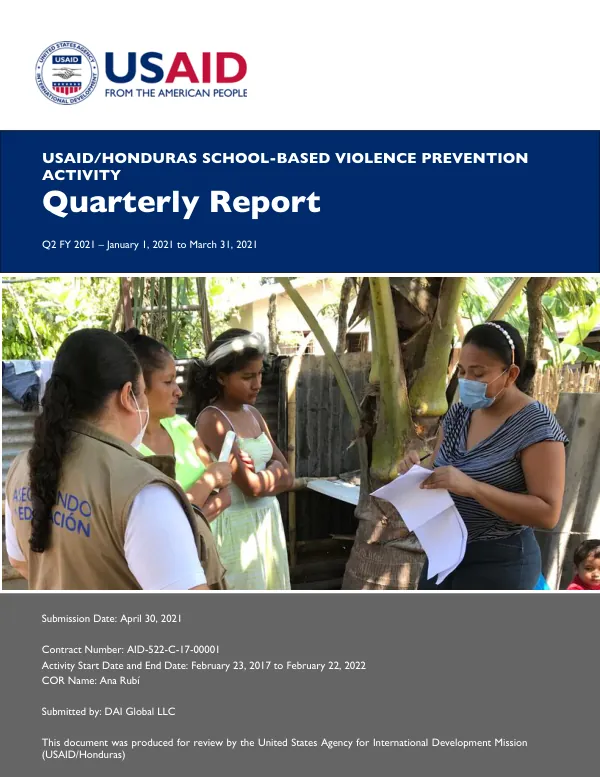
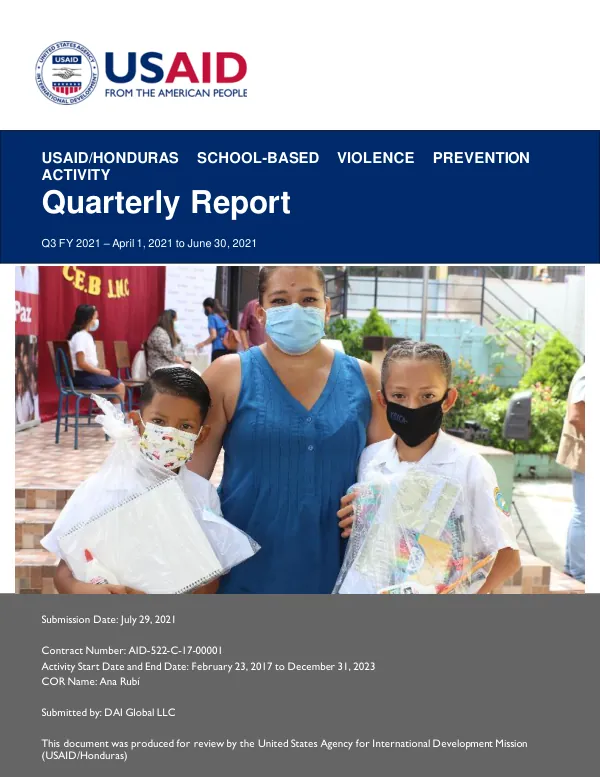
USAID/Honduras School-Based Violence Prevention Activity Quarterly Report – Q3 FY 2021
Sign inDAI GLOBAL, LLC
USAID/Honduras School-Based Violence Prevention Activity Quarterly Report – Q3 FY 2021
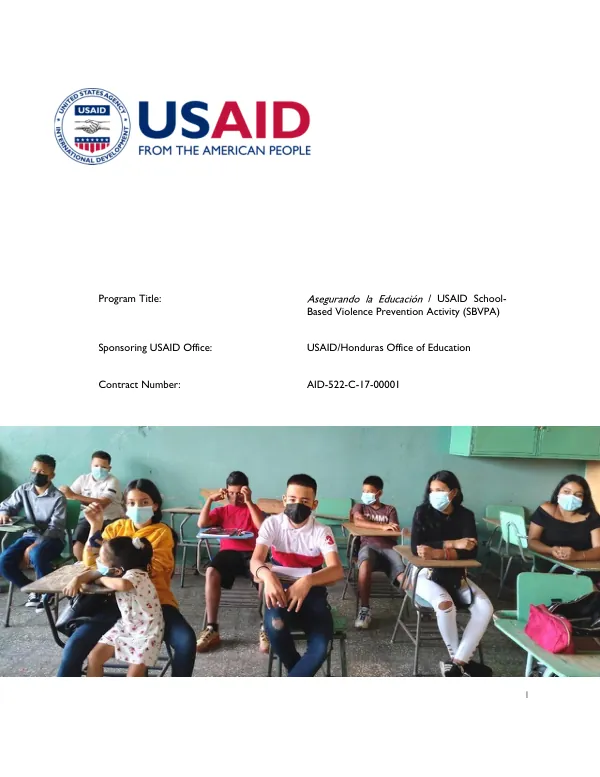
The USAID School-Based Violence Prevention Activity (SBVPA), also known as Asegurando la Educación, is a five-year, $20 million flagship effort funded by USAID.
2021 · 55 pages
Sign in to readA free account is required to download.
Abstract
The project aims to address school-based violence that impedes the delivery of education and its goals of access, retention, and learning in target communities. The four strategic project objectives are to improve schools' ability to reduce school-based violence and out-migration, strengthen local networks that increase school safety and curb migration, increase the capacity of the Ministry of Education (MOE) and social protection actors to prevent, respond to, report on, and monitor school-based violence, and lower risk factors and enhance protective factors for students that qualify for secondary prevention services (SPS) and are at risk of school drop-out and undocumented migration. The project operates in eight target municipalities: Tegucigalpa, San Pedro Sula, Choloma, La Ceiba, Comayagua, Puerto Cortés, El Progreso, and Tela. These municipalities are central to the 2020-2021 USAID/Honduras Country Development Cooperation Strategy under Development Objective 1 (DO1): Socio-economic Opportunities Improved to Reduce Irregular Migration and Development Objective 3 (DO3): Justice and Security Improved to Reduce Irregular Migration. The project also contributes to the second objective of the GOH 2010 Visión del País (Country Vision), promoting "strong systems of social protection," by supporting a commitment to democracy, security, and non-violence. Asegurando began the quarter advancing the 90-Day Plan to Curb Irregular Migration by expanding planned activities designed to keep young people engaged in school, learning, and progressing toward graduation and a future in Honduras. The plan involved enhancing activities that would have an immediate impact on improving enrollment and retention in the five original cities of operation and expanding key retention activities in 50 additional schools in three new municipalities that are among the top ten cities with the highest rates of out-migration: Comayagua, Puerto Cortés, and El Progreso. Of the eight cities in which Asegurando operated this quarter, seven ranked among the top ten. While Tela does not rank within the top ten, it does suffer a high rate of out-migration. The project strengthens education systems to address school-based violence, working to enhance the capacity of Government of Honduras (GOH) institutions, such as the MOE, the Ministry of Security (MOS), and other key social network actors at the national and municipal levels and among local civil society organizations (CSOs). The project does this by working in targeted schools, including primary schools or centros básicos (grades 1-9) and high schools or institutos (grades 7-11 or 12) across the eight target municipalities. The project also works to enhance the capacity of the MOE and social protection actors to prevent, respond to, report on, and monitor school-based violence. Asegurando contributes to the second objective of the GOH 2010 Visión del País (Country Vision), promoting "strong systems of social protection," by supporting a commitment to democracy, security, and non-violence. It also responds to the Plan del País (Country Plan), by linking education and violence prevention through the promotion of greater cohesion, and the Ley Fundamental de Educación (Fundamental Law of Education), which makes education for prevention and rehabilitation a cross-cutting issue in the national curriculum. The project has made adaptations to the Year Five Work Plan in coordination with USAID to respond to the COVID-19 crisis that began in Honduras in mid-March 2020 and that continues to affect the country in 2021. The adaptations also include activities that respond to the emergency created by the Tropical Storms Eta & Iota, and interventions implemented as part of the 90-Day Plan to Curb Irregular Migration running from March 29, 2021, through June 29, 2021. The project has implemented various activities to address school-based violence and out-migration, including enhancing activities that would have an immediate impact on improving enrollment and retention in the five original cities of operation and expanding key retention activities in 50 additional schools in three new municipalities that are among the top ten cities with the highest rates of out-migration. The project has also worked to enhance the capacity of the MOE and social protection actors to prevent, respond to, report on, and monitor school-based violence. Asegurando has made progress in implementing its activities, including expanding planned activities designed to keep young people engaged in school, learning, and progressing toward graduation and a future in Honduras. The project has also worked to enhance the capacity of the MOE and social protection actors to prevent, respond to, report on, and monitor school-based violence. The project's adaptations to the Year Five Work Plan have also helped to respond to the COVID-19 crisis and the emergency created by the Tropical Storms Eta & Iota.