USAID. MISSION TO INDONESIA
Education policy and planning (EPP)
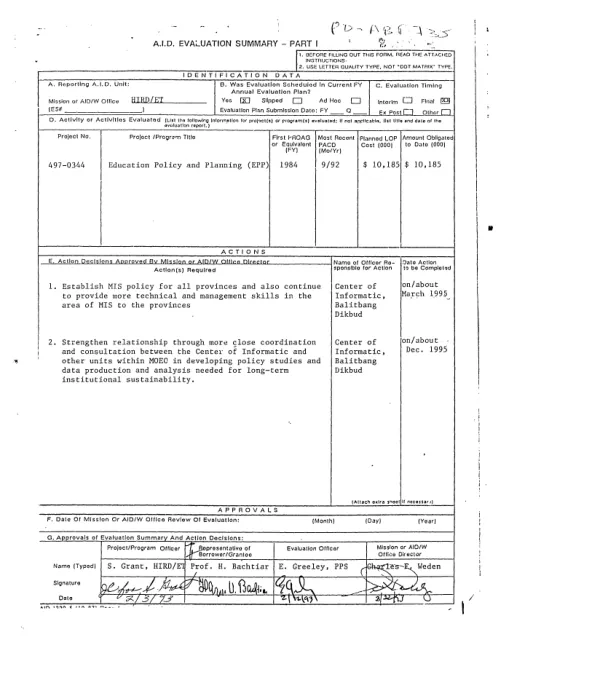
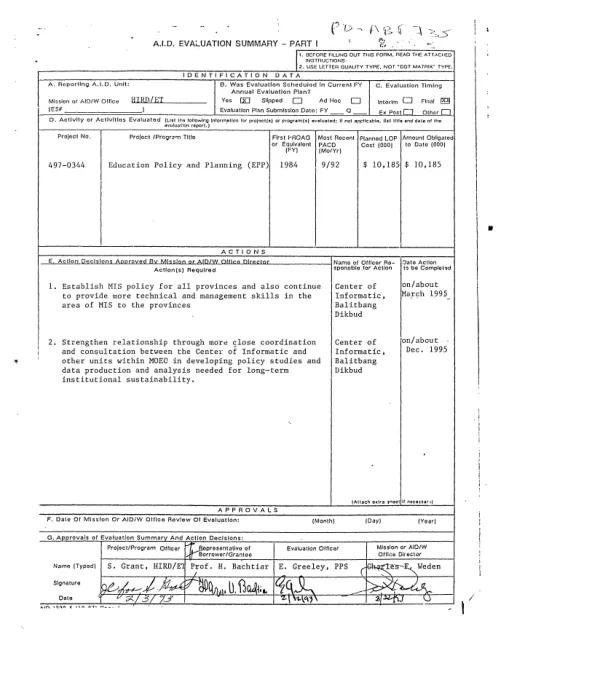
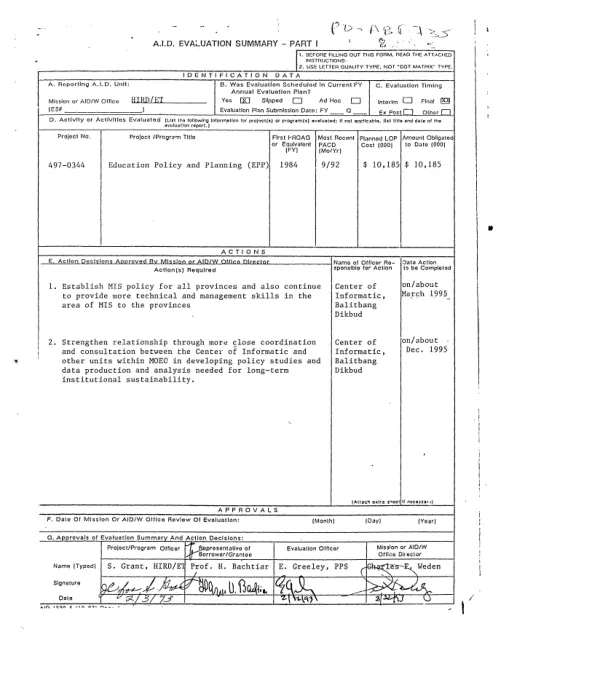
Summarizes final external evaluation (XD-ABF-735-A) of a project to upgrade the capability of Indonesia"s Ministry of Education and Culture (MOEC) to formulate and implement educational policies and plans.
1993
Sign in to readA free account is required to download.
Abstract
The evaluation covered the period 7/84-7/92. The project has helped MOEC"s Center for Information (Pusat Informatika) establish a computerized educational policy and planning management information system (EMIS) and has extended EMIS capability to all 27 provinces, greatly improving their data management capacity, although the extent of EMIS use varies among the provinces. In addition, the project has: (1) increased MOEC capacity for policy research and analysis; (2) improved the internal management of the Office for Educational and Cultural Research and Development (Balitbang Dikbud); (3) completed policy studies of cost analysis, finance, educational efficiency, low-cost learning materials, vocational/technical education, in-service training of primary school teachers, quality of basic education, and local education capacity; and (4) supported experimentation with planning and information systems at the provincial level. Personnel capabilities have been improved by U.S. training for 29 persons, including five Ph.D.s and six Master"s degrees, and in-country training at the federal and provincial levels for hundreds of persons in policy analysis/research and MIS. This has produced a hardworking, dedicated staff, especially in the Pusat Informatika, which is the project"s nerve center. Impacts on educational planning have been significant. The data generated and policy studies completed now constitute the main basis for MOEC input into the Government"s annual planning process, the next Five-Year plan, and the second 25-Year Plan. This has been accomplished in close coordination with other major government units such as the National Planning Board (BAPPENAS) and the Ministry of Finance. Impacts on policy have also been significant: a shift from an emphasis on system expansion (access) to one on quality and efficiency (relating education more closely to the demands of the labor market); extension of basic education from 6 to 9 years to insure a human resource base for industrial and technological development; and refocusing of investments in technical and vocational education. Two lessons were learned. (1) Project objectives must occasionally be modified in light of changing conditions or available technology. In the present project, initial objectives were broadened when microcomputers became available in 1986. (2) It is essential that host country supervisors make a commitment not to assign counterpart personnel to other major projects; otherwise, the foreign consultant may be working in a cultural and strategic vacuum, and technical transfer of knowledge and experience will be minimal.