USAID DEC
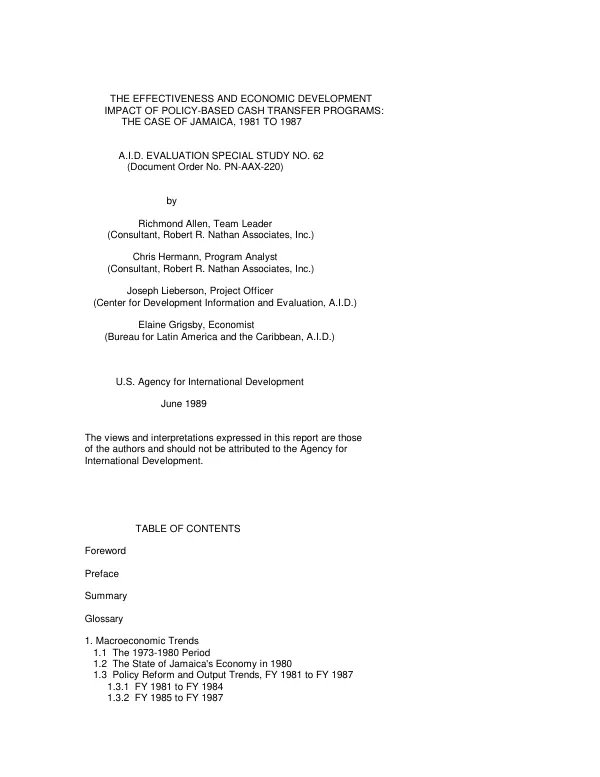
Effectiveness and economic development impact of policy-based cash transfer programs : the case of Jamaica, 1981-1987
Sign inUSAID. BUR. FOR PROGRAM AND POLICY COORDINATION. CENTER FOR DEVELOPMENT INFORMATION AND EVALUATION (CDIE)
Effectiveness and economic development impact of policy-based cash transfer programs : the case of Jamaica, 1981-1987
From 1973 to 1980, Jamaica underwent severe economic decline as a result of protectionist economic policies and greatly expanded social service programs.
Allen, Richmond; Hermann, Chris · 1989
Sign in to readA free account is required to download.
Abstract
In response, in 1981 A.I.D. initiated a cash transfer program which provided $396 million over a six-year period as support for economic stabilization and structural adjustment efforts. The program focused on reducing government involvement in commercial enterprises and in production and investment decisions, maximizing the role of the private sector in national development, and encouraging export-led growth. According to this evaluation, the Government of Jamaica achieved many, although not all, of the policy reform goals. Major achievements were: (1) the development of a simplified and equitable tax system; (2) privatization of a broad array of public sector enterprises; (3) deregulation of export marketing organizations, leading to increased investments in the banana, coffee, and citrus industries; (4) reduction of subsidies and elimination of commodity price controls; (5) reduction of quantitative import restrictions; and (6) the doubling of nontraditional exports to countries outside the Caribbean Common Market. A negative result of the economic stabilization program, however, has been the deterioration of Jamaican living standards and social services. According to the report, these conditions were made even more severe by the Government of Jamaica"s slowness in implementing economic stabilization policies. Serious efforts to make the exchange rate more competitive and to reduce central government expenditures were delayed until 1985, which only increased the strain on the poorest segments of the population. Three major lessons were learned. (1) Certain implementation requirements of structural adjustment and policy reform programs may be better addressed through project rather than program modes of assistance. (2) Cross-conditionality between two A.I.D. programs is likely to magnify problems that arise within each program. (3) Coordination and complementarity across the A.I.D. portfolio contribute to the policy dialogue and reform process.