USAID DEC
Effects of continued landlord presence in the Bolivian countryside during the post-reform era : lessons to be learned
Sign inUNIVERSITY OF WISCONSIN AT MADISON
Effects of continued landlord presence in the Bolivian countryside during the post-reform era : lessons to be learned
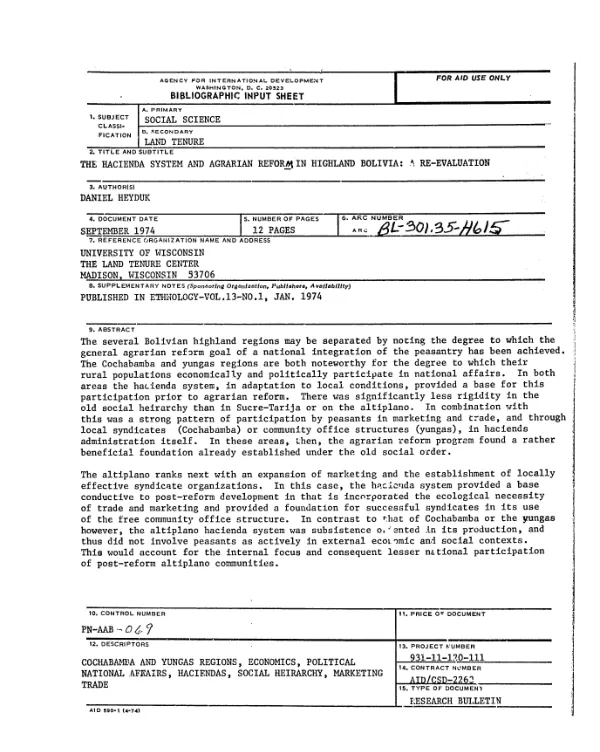
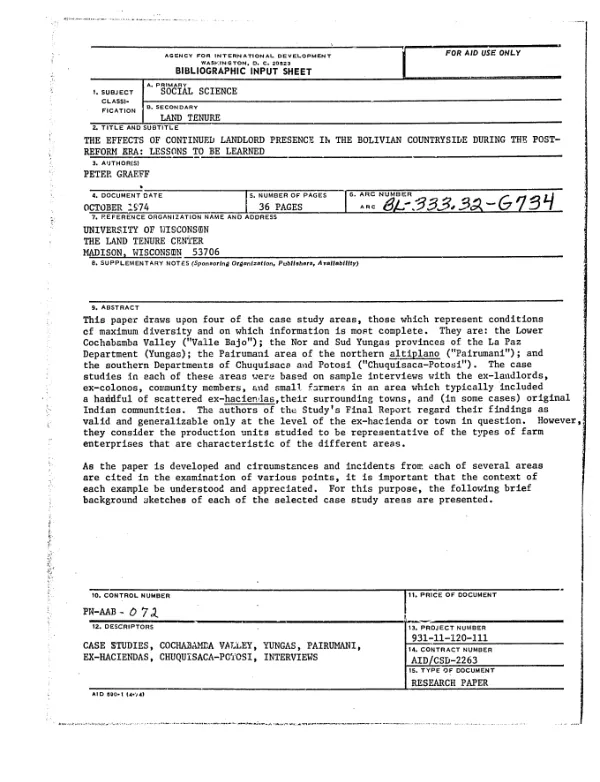
This paper draws upon four of the case study areas, those which represent conditions of maximum diversity and on which information is most complete.
Graeff, Peter · 1970
Sign in to readA free account is required to download.
Abstract
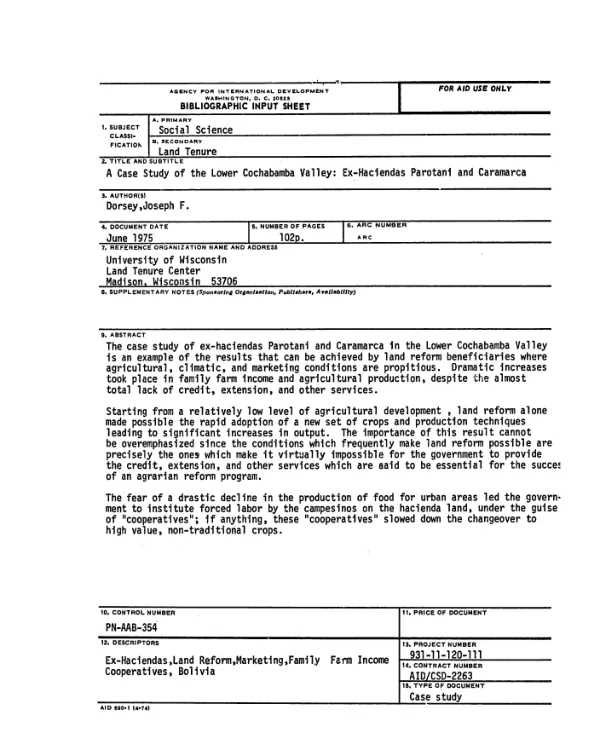
They are: the Lower Cochabamba Valley ("Valle Bajo"); the Nor and Sud Yungas provinces of the La Paz Department (Yungas); the Pairumani area of the northern altiplano ("Pairumani"); and the southern Departments of Chuquisaca and Potosi ("Chuquisaca-Potosi"). The case studies in each of these areas were based on sample interviews with the ex-landlords, ex-colonos, community members, and small farmers in an area which typically included a handful of scattered ex-haciendas, their surrounding towns, and (in some cases) original Indian communities. The authors of the Study"s Final Report regard their findings as valid and generalizable only at the level of the ex-hacienda or town in question. However, they consider the production units studied to be representative of the types of farm enterprises that are characteristic of the different areas. As the paper is developed and circumstances and incidents from each of several areas are cited in the examination of various points, it is important that the context of each example be understood and appreciated. For this purpose, the following brief background sketches of each of the selected case study areas are presented.
Connected topics