USAID DEC
Effects of Environmental Parameters on Salmonella Contaminated in Harvested Oysters
Salmonella contamination in harvested oysters is a significant public health concern, particularly in areas where wastewater discharges from anthropogenic activities are prevalent.
2019 · 1 pages
Sign in to readA free account is required to download.
Abstract
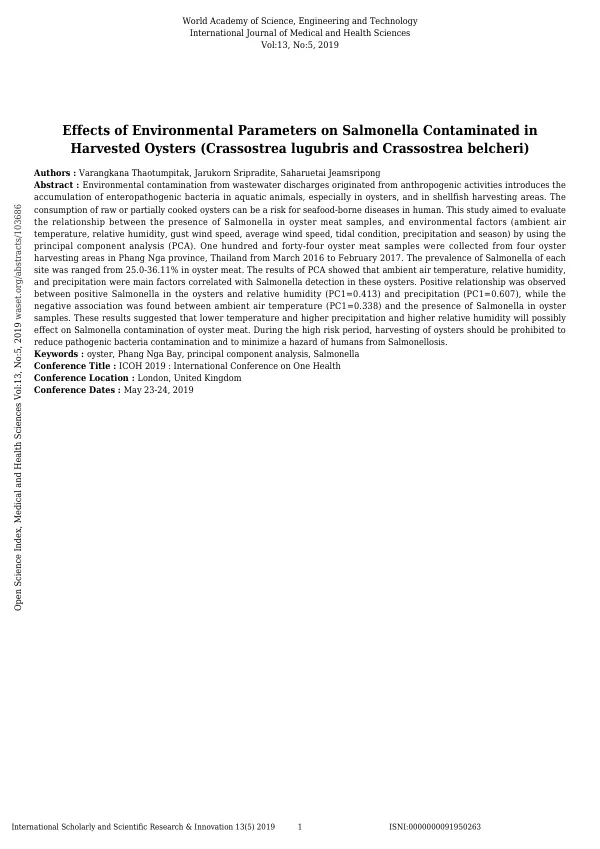
The consumption of raw or partially cooked oysters can lead to seafood-borne diseases in humans. This study aimed to investigate the relationship between the presence of Salmonella in oyster meat samples and environmental factors. A total of 144 oyster meat samples were collected from four oyster harvesting areas in Phang Nga province, Thailand, between March 2016 and February 2017. The prevalence of Salmonella in oyster meat samples ranged from 25.0% to 36.11% across the four sites. Principal component analysis (PCA) was used to evaluate the correlation between environmental factors and Salmonella detection in oysters. The results of PCA revealed that ambient air temperature, relative humidity, and precipitation were the primary factors correlated with Salmonella detection in oysters. A positive relationship was observed between positive Salmonella in oysters and relative humidity (PC1=0.413) and precipitation (PC1=0.607). Conversely, a negative association was found between ambient air temperature (PC1=0.338) and the presence of Salmonella in oyster samples. These findings suggest that lower temperatures, higher precipitation, and higher relative humidity may contribute to Salmonella contamination in oyster meat. The study's results have significant implications for oyster harvesting and food safety. During periods of high risk, harvesting of oysters should be prohibited to reduce pathogenic bacteria contamination and minimize the hazard of Salmonella infection in humans. The findings of this study highlight the importance of considering environmental factors in the management of oyster harvesting and the prevention of seafood-borne diseases. Phang Nga province, Thailand, is a significant oyster-producing region, and the results of this study have important implications for the local food industry and public health authorities. The study's findings can inform the development of effective strategies for reducing Salmonella contamination in oysters and minimizing the risk of seafood-borne diseases in humans.
Related documents
Documents in this collection
 2021
2021USAID DEC
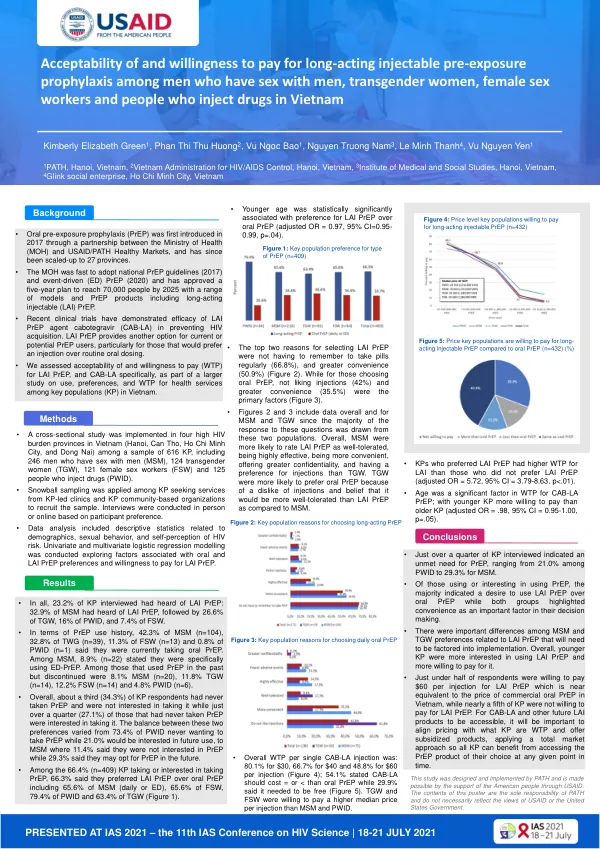
Acceptability of and willingness to pay for long-acting injectable pre-exposure prophylaxis among men who have sex with men, transgender women, female sex workers and people who inject drugs in Vietnam
Open record 2021
2021USAID DEC