USAID DEC
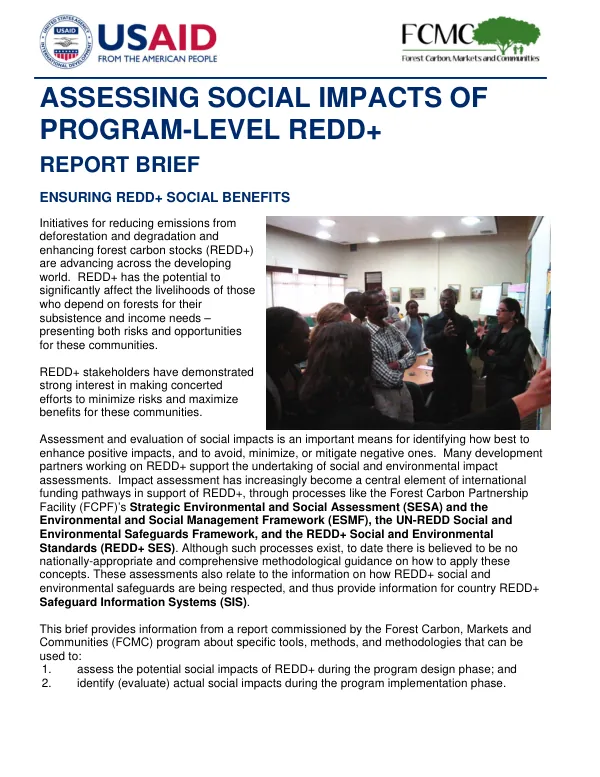
Elements of Social Impact Analysis and their relevance to National level REDD+
Social Impact Analysis is a systematic investigation of the effects of changes brought about by an intervention.
2012 · 25 pages
Sign in to readA free account is required to download.
Abstract
This implies three key components: an intervention, something that is acted upon or changed, and a resulting change or impact. An intervention can be a project, program, policy, or set of policies, while the situation or system being acted upon is bounded, defined by value and intention, and characterized by physical, environmental, economic, societal, institutional, and cultural characteristics. Social impacts are a subset of impacts, encompassing both positive and negative, intended and unintended, direct and indirect, primary and secondary effects produced by an intervention. Some social impacts may be of particular policy relevance, such as poverty, equity, and social exclusion. Poverty and Social Impact Analysis (PSIA) is an assessment of the distributional impact of specific policy reforms on the well-being or welfare of different stakeholder groups, with a focus on the poor and vulnerable. Social Impact Analysis involves examining various types of social impacts, including changes to people's way of life, culture, community, political systems, environment, health and well-being, personal and property rights, and fears and aspirations. These impacts can be influenced by factors such as the availability and quality of resources, the level of democratization, and the presence of hazards or risks. The main questions of Social Impact Analysis are who will be affected and how they will be affected. This requires a thorough understanding of the intervention, the situation or system being acted upon, and the potential social impacts that may arise. By addressing these questions, Social Impact Analysis can provide valuable insights for policymakers and stakeholders seeking to mitigate negative social impacts and maximize positive ones. In the context of National REDD+ programs, Social Impact Analysis is crucial for understanding the potential social consequences of forest conservation and sustainable forest management initiatives. By examining the social impacts of these interventions, policymakers can develop more effective strategies for addressing the needs of local communities and ensuring that the benefits of REDD+ programs are equitably distributed. The OECD DAC defines social impacts as the positive and negative, intended and unintended, direct and indirect, primary and secondary effects produced by an intervention. This definition highlights the complexity and multifaceted nature of social impacts, which can be influenced by a wide range of factors and have far-reaching consequences for individuals, communities, and societies as a whole. Social Impact Analysis is not a method, but an approach that can be applied to a variety of contexts and interventions. By adopting a systematic and comprehensive approach to social impact assessment, policymakers and stakeholders can gain a deeper understanding of the potential social consequences of their actions and make more informed decisions about how to mitigate negative impacts and maximize positive ones.